Advertisements
Advertisements
प्रश्न
In U. C. M (Uniform Circular Motion), prove the relation `vec v = vec w xx vec r`, where symbols have their usual meanings.
Advertisements
उत्तर
Analytical method :
Consider a particle revolving in the anticlockwise sense along the circumference of a circle of radius r with centre O as shown.
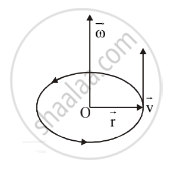
Let
`vec omega`= angular velocity of the particle
`vec v`= linear velocity of the particle
`vec r`= radius of the particle
In the vector form, the linear dispalcement is
`vec (delta s) = vec (delta theta) times vec r`
Dividing both sides by `delta t` we get
`vec (delta s)/(delta t) = vec (delta theta)/(delta t) times vec r`
`lim_(delta t -> 0) vec (delta s)/(delta t) = lim_(delta t -> 0) vec (delta theta)/(delta t) times vec r`
`therefore vec(dS)/dt = vec(d theta)/(delta t) times vec r`
but
`vec(dS)/dt = vec v` = Linear velocity
`vec(d theta)/(delta t) = vec omega` = angular velocity
`therefore vec v = vec omega times vec r`
APPEARS IN
संबंधित प्रश्न
A particle starts from the origin at t = 0 s with a velocity of 10.0 `hatj "m/s"` and moves in the x-y plane with a constant acceleration of `(8.0 hati + 2.0 hatj) ms^(-2)`.
- At what time is the x-coordinate of the particle 16 m? What is the y-coordinate of the particle at that time?
- What is the speed of the particle at the time?
Explain the meaning of uniform circular motion. Give one example of such motion.
A piece of stone tied at the end of a thread is whirled in a horizontal circle with uniform speed by hand. Answer the following questions:
- Is the velocity of stone uniform or variable?
- Is the acceleration of stone uniform or variable?
- What is the direction of acceleration of stone at any instant?
- Which force provides the centripetal force required for circular motion?
- Name the force and its direction which acts on the hand.
The motion of the moon around the earth in a circular path is an accelerated motion.
In a uniform circular motion, the speed continuously changes because of the direction of motion changes.
Name the force required for uniform circular motion. State its direction.
Solve the following problem.
A particle moves in a circle with a constant speed of 15 m/s. The radius of the circle is 2 m. Determine the centripetal acceleration of the particle.
Which one of the following is most likely not a case of uniform circular motion?
Which of the following graph represents uniform motion of a moving particle?
What is meant by uniform circular motion? Give two examples of uniform circular motion.
The ratio of angular speed of a hour-hand to the second-hand of a watch is ____________.
A particle performs uniform circular motion in a horizontal plane. The radius of the circle is 8 cm. The centripetal force acting on the particle is 15 N. Its kinetic energy is ____________.
A disc has mass 'M' and radius 'R'. How much tangential force should be applied to the rim of the disc, so as to rotate with angular velocity 'ω' in time t?
At any instant, the magnitude of the centripetal force on a particle of mass 'm' performing circular motion is given by (ω = angular velocity and v = linear velocity of the particle) ______.
A ball of mass 'm' is attached to the free end of an inextensible string of length 'l'. Let 'T' be the tension in the string. The ball is moving in horizontal circular path about the vertical axis. The angular velocity of the ball at any particular instant will be ______.
A body moves in a uniform circular motion ______.
Earth also moves in circular orbit around sun once every year with on orbital radius of 1.5 × 10¹¹ m. What is the acceleration of earth (or any object on the surface of the earth) towards the centre of the sun? How does this acceleration compare with g = 9.8 m/s2?
A small bead of mass m can move on a smooth circular wire (radius R) under the action of a force F = `"Km"/"r"^2` directed (r = position of bead r from P and K = constant) towards a point P within the circle at a distance R/2 from the centre. The minimum velocity should be ______ m/s of bead at the point of the wire nearest the centre of force (P) so that bead will complete the circle. (Take `"k"/(3"R")` = 8 unit)

The distance of the Sun from earth is 1.5 × 10¹¹ m and its angular diameter is (2000) s when observed from the earth. The diameter of the Sun will be ______.
A rod PQ of mass M and length L is hinged at end P. The rod is kept horizontal by a massless string tied to point Q as shown in figure. When string is cut, the initial angular acceleration of the rod is ______.

A ceiling fan rotates about its own axis with some angular velocity. When the fan is switched off the angular velocity becomes `(1/4)^"th"` of the original in time 't' and 'n' revolutions are made in that time. The number of revolutions made by the fan during the time interval between switch off and rest are ______. (Angular retardation is uniform)
A particle moves along a circle of radius r with constant tangential acceleration. If the velocity of the particle is v at the end of second revolution, after the revolution has started, then the tangential acceleration is ______.
A body of mass m is moving in circle of radius r with a constant speed v. The work done by the centripetal force in moving the body over half the circumference of the circle is ______.
In uniform circular motion, although the speed is constant, why does acceleration occur?
What is the direction of the velocity of an object at any point during uniform circular motion?
What is the direction of the velocity of an object at any point during uniform circular motion?
Angular displacement is measured in which unit?
A particle moving with uniform speed in a circular path maintains ______.
