Advertisements
Advertisements
प्रश्न
For a particle performing uniform circular motion `vecv=vecomegaxxvecr`obtain an expression for linear acceleration of the particle performing non-uniform circular motion.
Advertisements
उत्तर
`vecv=vecomegaxxvecr`
`vec(dv)/dt=vec(domega)/dtxxvecr+vecomegaxxvec(dr)/dt`
where
`(dvecomega)/dt=vecalpha,`
`(dr)/dt=vecv`
`(dvecv)/dt=veca`
`:.veca=vecalphaxxvecr+vecomegaxxvecv`
APPEARS IN
संबंधित प्रश्न
Earth moves around the sun with uniform velocity.
Draw a neat labelled diagram for a particle moving in a circular path with a constant speed. In you diagram show the direction of velocity at any instant.
Is it possible to have an accelerated motion with a constant speed? Name such type of motion.
State True or False
The earth moves around the sun with a uniform.
The motion of the moon around the earth in a circular path is an accelerated motion.
A uniform linear motion is unaccelerated, while a uniform circular motion is an accelerated motion.
Which of the following quantity remains constant in uniform circular motion:
Complete a sentence and explain it.
When an object is in uniform circular motion, its ______ changes at every point.
Name the force required for uniform circular motion. State its direction.
Define Uniform circular motion.
What is a conical pendulum?
Is the uniform circular motion accelerated? Give reasons for your answer.
A uniform rod of length '6L' and mass '8 m' is pivoted at its centre 'C'. Two masses 'm' and ' 2m' with speed 2v, v as shown strikes the rod and stick to the rod. Initially the rod is at rest. Due to impact, if it rotates with angular velocity 'w1' then 'w' will be ________.

A particle goes round a circular path with uniform speed v. After describing half the circle, what is the change in its centripetal acceleration?
The ratio of angular speed of a hour-hand to the second-hand of a watch is ____________.
A particle performs uniform circular motion in a horizontal plane. The radius of the circle is 8 cm. The centripetal force acting on the particle is 15 N. Its kinetic energy is ____________.
A wheel is 0.25 m in radius. When it makes 15 revolutions per minute, its linear speed at the point on circumference is ____________.
Statement A: Uniform circular motion is a case of accelerated motion
Statement B: In the third equation of motion we do not have the term time
Define uniform circular motion and give an example of it. Why is it called accelerated motion?
A body moving along a circular path of radius R with velocity v, has centripetal acceleration a. If its velocity is made equal to 2v. What will be the centripetal acceleration?
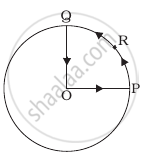
A cyclist starts from centre O of a circular park of radius 1 km and moves along the path OPRQO as shown figure. If he maintains constant speed of 10 ms–1, what is his acceleration at point R in magnitude and direction?
Earth can be thought of as a sphere of radius 6400 km. Any object (or a person) is performing circular motion around the axis of earth due to earth’s rotation (period 1 day). What is acceleration of object on the surface of the earth (at equator) towards its centre? what is it at latitude θ? How does these accelerations compare with g = 9.8 m/s2?
Earth also moves in circular orbit around sun once every year with on orbital radius of 1.5 × 10¹¹ m. What is the acceleration of earth (or any object on the surface of the earth) towards the centre of the sun? How does this acceleration compare with g = 9.8 m/s2?
The kinetic energy K of a particle moving along a circle of radius R depends on the distance covered s as K = as2, where a is a constant. The force acting on the particle is ______.
The relationship between an object's linear velocity (v) and its angular velocity (ω) in a circular path of radius (r) is given by:
In uniform circular motion, although the speed is constant, why does acceleration occur?
What is the direction of the velocity of an object at any point during uniform circular motion?
