Advertisements
Advertisements
प्रश्न
Answer the following question.
Show that the centripetal force on a particle undergoing uniform circular motion is -mrω2.
Advertisements
उत्तर
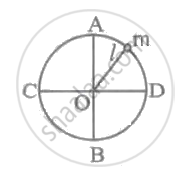
- Suppose a particle is performing U.C.M in anticlockwise direction. The co-ordinate axes are chosen as shown in the figure.
Let, A = initial position of the particle which lies on positive X-axis
P = instantaneous position after time t
θ = angle made by radius vector
ω = constant angular speed
`vec"r"` = instantaneous position vector at time t - From the figure,
`vec"r" = hat"i""x" + hat"j""y"`
where, `hat"i" and hat"j"` are unit vectors along X-axis and Y-axis respectively.
- Also, x = r cos θ and y = r sin θ
∴ `vec"r" = ["r"hat"i"cos theta + "r"hat"j"sin theta]`
But θ = ωt
∴ `vec"r" = ["r"hat"i" cos omega"t" + "r"hat"j" sin omega"t"]` ....(1) - Velocity of the particle is given as rate of change of position vector.
∴ `vec"v" = (vec"dr")/"dt" = "d"/"dt" ["r"hat"i" cos omega"t" + "r" hat"j" sin omega"t"]`
`= "r"["d"/"dt" cos omega"t"]hat"i" + "r"["d"/"dt" sin omega"t"]hat"j"`
∴ `vec"v" = - "r"omega hat"i" sin omega"t" + "r"omega hat"j" cos omega"t"`
∴ `vec"v" = "r"omega (-hat"i" sin omega"t" + hat"j" cos omega"t")` - Further, instantaneous linear acceleration of the particle at instant t is given by,
`vec"a" = (vec"dv")/"dt" = "d"/"dt"["r"omega(- hat"i" sin omega "t" + hat"j" cos omega"t")]`
`= "r"omega ["d"/"dt" (- hat"i" sin omega"t" + hat"j" cos omega "t")]`
`= "r"omega ["d"/"dt" (- sin omega"t")hat"i" + "d"/"dt"(cos omega "t")hat"j"]`
`= "r"omega(-omega hat"i" cos omega"t" - omega hat"j" sin omega "t")`
`= - "r"omega^2(hat"i" cos omega "t" + hat"j" sin omega"t")`
∴ `vec"a" = - omega^2("r"hat"i" cos omega"t" + "r" hat"j" sin omega "t")` ....(2) - From equation (1) and (2),
`vec"a" = - omega^2vec"r"` ....(3)
The negative sign shows that the direction of acceleration is opposite to the direction of the position vector. Equation (3) is the centripetal acceleration. - The magnitude of centripetal acceleration is given by,
a = `omega^2"r"` - The force providing this acceleration should also be in the same direction, hence centripetal.
∴ `vec"F" = "m"vec"a" = - "m"omega^2vec"r"`
This is the expression for the centripetal force on a particle undergoing uniform circular motion. - Magnitude of F = `"m"omega^2"r" = "mv"^2/"r"` = mωv
APPEARS IN
संबंधित प्रश्न
Draw a neat labelled diagram of conical pendulum. State the expression for its periodic time in terms of length.
A stone tied to the end of a string 80 cm long is whirled in a horizontal circle with a constant speed. If the stone makes 14 revolutions in 25 s, what is the magnitude and direction of acceleration of the stone?
A cyclist is riding with a speed of 27 km/h. As he approaches a circular turn on the road of radius 80 m, he applies brakes and reduces his speed at the constant rate of 0.50 m/s every second. What is the magnitude and direction of the net acceleration of the cyclist on the circular turn?
A vehicle is moving on a circular track whose surface is inclined towards the horizon at an angle of 10°. The maximum velocity with which it can move safely is 36 km / hr. Calculate the length of the circular track. [π = 3.142]
Explain the meaning of uniform circular motion. Give one example of such motion.
Give an example of motion in which speed remains uniform, but the velocity changes.
| A small pebble tied at one end of a string is placed near the periphery of a circular disc, at the centre of which the other end of the string is tied to a peg. The disc is rotating about an axis passing through its centre. |
- What will be your observation when you are standing outside the disc? Explain.
- What will be your observation when you are standing at the centre of the disc? Explain.
In a uniform circular motion, the speed continuously changes because of the direction of motion changes.
Name the force required for uniform circular motion. State its direction.
What is a conical pendulum?
Answer the following question.
Show that its time period is given by, 2π`sqrt((l cos theta)/("g"))` where l is the length of the string, θ is the angle that the string makes with the vertical, and g is the acceleration due to gravity.
Which of the following graph represents uniform motion of a moving particle?
The angle subtended by the vector A = `5hat"i" + 3hat"j" + 12hat"k"` with the X-axis is ______.
A uniform rod of length '6L' and mass '8 m' is pivoted at its centre 'C'. Two masses 'm' and ' 2m' with speed 2v, v as shown strikes the rod and stick to the rod. Initially the rod is at rest. Due to impact, if it rotates with angular velocity 'w1' then 'w' will be ________.

A small sphere is attached to a cord and rotates in a vertical circle about a point O. If the average speed of the sphere is increased, the cord is most likely to break at the orientation when the mass is at ____________.
A particle is moving in uniform circular motion with speed 'V' and radius 'R'. The angular acceleration of the particle is ______.
A disc has mass 'M' and radius 'R'. How much tangential force should be applied to the rim of the disc, so as to rotate with angular velocity 'ω' in time t?
Two particles P and Q are moving in concentric circles of rarui rp and rQ respectively. If their period of revolutions are in ratio 2 : 3, then ratio of their centripetal acceleration is ____________.
A string of length `l` is fixed at one end and carries a mass 'm' at the other end. The mass is revolving along a horizontal circle of radius 'r' making 'θ' as the semi-vertical angle of cone and `(1/pi)` revolutions per second around the vertical axis through fixed end. The tension in the string is ______.
The motion of the bus is ______ motion.
It is possible to have objects moving with uniform velocity but non-uniform acceleration.
A particle is given an initial speed u inside a smooth spherical shell of radius R = 1 m that it is just able to complete the circle. Acceleration of the particle when its velocity is vertical is ______.

A simple pendulum of length l has maximum angular displacement θ. The maximum kinetic energy of the bob of mass m is ______.
(g = acceleration due to gravity)
The relationship between an object's linear velocity (v) and its angular velocity (ω) in a circular path of radius (r) is given by:
In uniform circular motion, although the speed is constant, why does acceleration occur?
By applying Kepler's third law to the formula for centripetal force, Newton concluded that the force acting on a planet is:
