Advertisements
Advertisements
प्रश्न
Answer the following question.
Show that the centripetal force on a particle undergoing uniform circular motion is -mrω2.
Advertisements
उत्तर
- Suppose a particle is performing U.C.M in anticlockwise direction. The co-ordinate axes are chosen as shown in the figure.
Let, A = initial position of the particle which lies on positive X-axis
P = instantaneous position after time t
θ = angle made by radius vector
ω = constant angular speed
`vec"r"` = instantaneous position vector at time t - From the figure,
`vec"r" = hat"i""x" + hat"j""y"`
where, `hat"i" and hat"j"` are unit vectors along X-axis and Y-axis respectively.
- Also, x = r cos θ and y = r sin θ
∴ `vec"r" = ["r"hat"i"cos theta + "r"hat"j"sin theta]`
But θ = ωt
∴ `vec"r" = ["r"hat"i" cos omega"t" + "r"hat"j" sin omega"t"]` ....(1) - Velocity of the particle is given as rate of change of position vector.
∴ `vec"v" = (vec"dr")/"dt" = "d"/"dt" ["r"hat"i" cos omega"t" + "r" hat"j" sin omega"t"]`
`= "r"["d"/"dt" cos omega"t"]hat"i" + "r"["d"/"dt" sin omega"t"]hat"j"`
∴ `vec"v" = - "r"omega hat"i" sin omega"t" + "r"omega hat"j" cos omega"t"`
∴ `vec"v" = "r"omega (-hat"i" sin omega"t" + hat"j" cos omega"t")` - Further, instantaneous linear acceleration of the particle at instant t is given by,
`vec"a" = (vec"dv")/"dt" = "d"/"dt"["r"omega(- hat"i" sin omega "t" + hat"j" cos omega"t")]`
`= "r"omega ["d"/"dt" (- hat"i" sin omega"t" + hat"j" cos omega "t")]`
`= "r"omega ["d"/"dt" (- sin omega"t")hat"i" + "d"/"dt"(cos omega "t")hat"j"]`
`= "r"omega(-omega hat"i" cos omega"t" - omega hat"j" sin omega "t")`
`= - "r"omega^2(hat"i" cos omega "t" + hat"j" sin omega"t")`
∴ `vec"a" = - omega^2("r"hat"i" cos omega"t" + "r" hat"j" sin omega "t")` ....(2) - From equation (1) and (2),
`vec"a" = - omega^2vec"r"` ....(3)
The negative sign shows that the direction of acceleration is opposite to the direction of the position vector. Equation (3) is the centripetal acceleration. - The magnitude of centripetal acceleration is given by,
a = `omega^2"r"` - The force providing this acceleration should also be in the same direction, hence centripetal.
∴ `vec"F" = "m"vec"a" = - "m"omega^2vec"r"`
This is the expression for the centripetal force on a particle undergoing uniform circular motion. - Magnitude of F = `"m"omega^2"r" = "mv"^2/"r"` = mωv
APPEARS IN
संबंधित प्रश्न
For a particle performing uniform circular motion `vecv=vecomegaxxvecr`obtain an expression for linear acceleration of the particle performing non-uniform circular motion.
Read the statement below carefully and state, with reason, if it is true or false:
The acceleration vector of a particle in uniform circular motion averaged over one cycle is a null vector.
A particle starts from the origin at t = 0 s with a velocity of 10.0 `hatj "m/s"` and moves in the x-y plane with a constant acceleration of `(8.0 hati + 2.0 hatj) ms^(-2)`.
- At what time is the x-coordinate of the particle 16 m? What is the y-coordinate of the particle at that time?
- What is the speed of the particle at the time?
Is it possible to have an accelerated motion with a constant speed? Explain
In a uniform circular motion, the speed continuously changes because of the direction of motion changes.
Which of the following remains constant in a uniform circular motion, Speed or Velocity, or both?
Define angular velocity.
Which one of the following is most likely not a case of uniform circular motion?
Is the uniform circular motion accelerated? Give reasons for your answer.
The ratio of angular speed of a hour-hand to the second-hand of a watch is ____________.
The ratio of the angular speed of minute hand and hour hand of a watch is ____________.
A particle performs uniform circular motion in a horizontal plane. The radius of the circle is 8 cm. The centripetal force acting on the particle is 15 N. Its kinetic energy is ____________.
Select the WRONG statement.
A particle is perfonning uniform circular motion. If 'θ', 'ω', 'α' and ' a' are its angular displacement, angular velocity, angular acceleration, and centripetal acceleration respectively, then which of the following is 'WRONG'?
A mass 'm' is tied to one end of a spring and whirled in a horizontal circle with constant angular velocity. The elongation in the spring is 1 cm. If the angular speed is doubled, the elongation in the spring is 6 cm. The original length of the spring is ______.
The angular speed of the minute hand of a clock in degrees per second is ______.
A body moves in a uniform circular motion ______.
Statement A: Uniform circular motion is a case of accelerated motion
Statement B: In the third equation of motion we do not have the term time
Which of the following is correct about uniform circular motion
- the direction of motion is continuously changed
- the direction of motion is not changed
- speed and direction both remain constant
- speed is constant but the direction is changing
Define uniform circular motion and give an example of it. Why is it called accelerated motion?
A point object moves along an arc of a circle of radius 'R'. Its velocity depends upon the distance covered 'S' as V = `Ksqrt(S)` where 'K' is a constant. If 'e' is the angle between the total acceleration and tangential acceleration, then
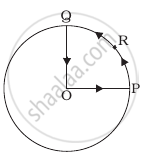
A cyclist starts from centre O of a circular park of radius 1 km and moves along the path OPRQO as shown figure. If he maintains constant speed of 10 ms–1, what is his acceleration at point R in magnitude and direction?
A particle is given an initial speed u inside a smooth spherical shell of radius R = 1 m that it is just able to complete the circle. Acceleration of the particle when its velocity is vertical is ______.

A wet open umbrella is held upright and is rotated about the handle at a uniform rate of 21 revolutions in 44 s. If the rim of the umbrella is a circle of 1 metre in diameter and the height of the rim above the floor is 1.5 m, the drops of water spun off the rim and hit the floor at a horizontal ______ m from the umbrella.
A wheel rotating at the same angular speed undergoes constant angular retardation. After the revolution, angular velocity reduces to half its initial value. It will make ______ revolution before stopping.
A particle moves along a circle of radius r with constant tangential acceleration. If the velocity of the particle is v at the end of second revolution, after the revolution has started, then the tangential acceleration is ______.
A body of mass m is moving in circle of radius r with a constant speed v. The work done by the centripetal force in moving the body over half the circumference of the circle is ______.
By applying Kepler's third law to the formula for centripetal force, Newton concluded that the force acting on a planet is:
Angular displacement is measured in which unit?
