Advertisements
Advertisements
प्रश्न
Solve the following problem.
A car moves in a circle at a constant speed of 50 m/s and completes one revolution in 40 s. Determine the magnitude of the acceleration of the car.
Advertisements
उत्तर १
Given: v = 50 m/s, t = 40 s, s = 2πr
To find: acceleration (a)
Formulae:
i. v = `"s"/"t"`
ii. a = `"v"^2/"r"`
Calculation: From formula (i),
`50 = (2pi"r")/40`
∴ r = `(50 xx 40)/(2pi)`
∴ r = `1000/pi` cm
From formula (ii),
a = `"v"^2/"r" = 50^2/(1000//pi)`
a = `(5pi)/2 = 7.85 "m"//"s"^2`
The magnitude of acceleration of the car is 7.85 m/s2.
उत्तर २
Given: v = 50 m/s, t = 40 s,
To find: acceleration (a)
Formula: a = rω2 = vω
Calculation: From formula,
a = vω
`= "v"(("2"pi)/"t")`
`= 50((2 xx 3.142)/40)`
`= 5/2 xx 3.142`
∴ a = 7.85 m/s2
APPEARS IN
संबंधित प्रश्न
Draw a neat labelled diagram of conical pendulum. State the expression for its periodic time in terms of length.
A particle starts from the origin at t = 0 s with a velocity of 10.0 `hatj "m/s"` and moves in the x-y plane with a constant acceleration of `(8.0 hati + 2.0 hatj) ms^(-2)`.
- At what time is the x-coordinate of the particle 16 m? What is the y-coordinate of the particle at that time?
- What is the speed of the particle at the time?
A cyclist is riding with a speed of 27 km/h. As he approaches a circular turn on the road of radius 80 m, he applies brakes and reduces his speed at the constant rate of 0.50 m/s every second. What is the magnitude and direction of the net acceleration of the cyclist on the circular turn?
How does uniform circular motion differ from uniform linear motion?
Is it possible to have an accelerated motion with a constant speed? Explain.
Answer the following question.
Show that the centripetal force on a particle undergoing uniform circular motion is -mrω2.
The angle subtended by the vector A = `5hat"i" + 3hat"j" + 12hat"k"` with the X-axis is ______.
If a particle moves with uniform speed then its tangential acceleration will be ______.
A particle goes round a circular path with uniform speed v. After describing half the circle, what is the change in its centripetal acceleration?
The ratio of angular speed of a hour-hand to the second-hand of a watch is ____________.
A small sphere is attached to a cord and rotates in a vertical circle about a point O. If the average speed of the sphere is increased, the cord is most likely to break at the orientation when the mass is at ____________.
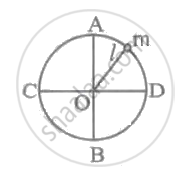
A particle of mass m is executing uniform circular motion on a path of radius r. If p is the magnitude of its linear momentum, the radial force acting on the particle is ______.
Certain neutron stars are believed to be rotating at about 1 rev/s. If such a star has a radius of 1.6 km, the acceleration of an object on the equator of the star will be nearly ____________.
A ball of mass 'm' is attached to the free end of an inextensible string of length 'l'. Let 'T' be the tension in the string. The ball is moving in horizontal circular path about the vertical axis. The angular velocity of the ball at any particular instant will be ______.
A string of length 'l' fixed at one end carries a mass 'm' at the other end. The string makes `3/pi` revolutions/second around the vertical axis through the fixed end as shown in figure. The tension 'T' in the string is ______.

A mass 'm' is tied to one end of a spring and whirled in a horizontal circle with constant angular velocity. The elongation in the spring is 1 cm. If the angular speed is doubled, the elongation in the spring is 6 cm. The original length of the spring is ______.
Two particles P and Q are moving in concentric circles of rarui rp and rQ respectively. If their period of revolutions are in ratio 2 : 3, then ratio of their centripetal acceleration is ____________.
Statement A: Uniform circular motion is a case of accelerated motion
Statement B: In the third equation of motion we do not have the term time
A body is said to be in nonuniform motion if it travels ______.
If a body is moving in a circle of radius r with a constant speed v, its angular velocity is ______.
Earth can be thought of as a sphere of radius 6400 km. Any object (or a person) is performing circular motion around the axis of earth due to earth’s rotation (period 1 day). What is acceleration of object on the surface of the earth (at equator) towards its centre? what is it at latitude θ? How does these accelerations compare with g = 9.8 m/s2?
A disc of radius 5 cm rolls on a horizontal surface with linear velocity v = 1`hat"i"` m/s and angular velocity 50 rad/s. Height of particle from ground on rim of disc which has velocity in vertical direction is ______ cm.
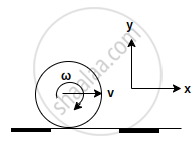
A wheel rotating at the same angular speed undergoes constant angular retardation. After the revolution, angular velocity reduces to half its initial value. It will make ______ revolution before stopping.
A wheel is rotating at 900 rpm about its axis. When the power is cut off it comes to rest in 1 min. The angular retardation (assumed to be uniform (in rad s-1) is ______.
A thin uniform circular disc of mass M and radius R is rotating in a horizontal plane about an axis passing through its centre and perpendicular to its plane with an angular velocity ω. Another disc of same dimensions, but of mass `1/4`M is placed gently on the first disc co-axially. The. angular velocity of the system is ______.
The relationship between an object's linear velocity (v) and its angular velocity (ω) in a circular path of radius (r) is given by:
What is the direction of the velocity of an object at any point during uniform circular motion?
The relationship between an object's linear velocity (v) and its angular velocity (ω) in a circular path of radius (r) is given by:
