Advertisements
Advertisements
प्रश्न
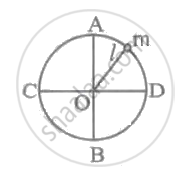
For a particle performing uniform circular motion, choose the correct statement(s) from the following:
- Magnitude of particle velocity (speed) remains constant.
- Particle velocity remains directed perpendicular to radius vector.
- Direction of acceleration keeps changing as particle moves.
- Angular momentum is constant in magnitude but direction keeps changing.
Advertisements
उत्तर
a, b and c
Explanation:

For a particle performing uniform circular motion.
- Speed will be constant throughout.
- Velocity will be tangential in the direction of motion at a particular point.
- Acceleration `a = v^2/r` will always be towards centre of the circular path.
- Angular momentum (mvr) is constant in magnitude and direction/out of the plane perpendicularly as well.
APPEARS IN
संबंधित प्रश्न
Explain the meaning of uniform circular motion. Give one example of such motion.
| A small pebble tied at one end of a string is placed near the periphery of a circular disc, at the centre of which the other end of the string is tied to a peg. The disc is rotating about an axis passing through its centre. |
- What will be your observation when you are standing outside the disc? Explain.
- What will be your observation when you are standing at the centre of the disc? Explain.
In a uniform circular motion, the speed continuously changes because of the direction of motion changes.
Solve the following problem.
A car moves in a circle at a constant speed of 50 m/s and completes one revolution in 40 s. Determine the magnitude of the acceleration of the car.
A small sphere is attached to a cord and rotates in a vertical circle about a point O. If the average speed of the sphere is increased, the cord is most likely to break at the orientation when the mass is at ____________.
Consider a simple pendulum of length 4 m. Its bob performs a circular motion in horizontal plane with its string making an angle 60° with the vertical. The Period of rotation of the bob is ____________.(Take g = 10 m/s2)
At any instant, the magnitude of the centripetal force on a particle of mass 'm' performing circular motion is given by (ω = angular velocity and v = linear velocity of the particle) ______.
Which of the following is correct about uniform circular motion
- the direction of motion is continuously changed
- the direction of motion is not changed
- speed and direction both remain constant
- speed is constant but the direction is changing
The motion of the bus is ______ motion.
It is possible to have objects moving with uniform velocity but non-uniform acceleration.
If a body is moving in a circle of radius r with a constant speed v, its angular velocity is ______.
A particle is given an initial speed u inside a smooth spherical shell of radius R = 1 m that it is just able to complete the circle. Acceleration of the particle when its velocity is vertical is ______.

A small bead of mass m can move on a smooth circular wire (radius R) under the action of a force F = `"Km"/"r"^2` directed (r = position of bead r from P and K = constant) towards a point P within the circle at a distance R/2 from the centre. The minimum velocity should be ______ m/s of bead at the point of the wire nearest the centre of force (P) so that bead will complete the circle. (Take `"k"/(3"R")` = 8 unit)

A thin uniform circular disc of mass M and radius R is rotating in a horizontal plane about an axis passing through its centre and perpendicular to its plane with an angular velocity ω. Another disc of same dimensions, but of mass `1/4`M is placed gently on the first disc co-axially. The. angular velocity of the system is ______.
The kinetic energy K of a particle moving along a circle of radius R depends on the distance covered s as K = as2, where a is a constant. The force acting on the particle is ______.
Why is uniform circular motion said to be accelerated?
What is the direction of the velocity of an object at any point during uniform circular motion?
What is the direction of the velocity of an object at any point during uniform circular motion?
