Advertisements
Advertisements
प्रश्न
Name the force required for uniform circular motion. State its direction.
Advertisements
उत्तर
Force required for uniform circular motion is the centripetal force. It is directed towards its centre i.e., the centre of the circle.
संबंधित प्रश्न
A particle starts from the origin at t = 0 s with a velocity of 10.0 `hatj "m/s"` and moves in the x-y plane with a constant acceleration of `(8.0 hati + 2.0 hatj) ms^(-2)`.
- At what time is the x-coordinate of the particle 16 m? What is the y-coordinate of the particle at that time?
- What is the speed of the particle at the time?
Why is the motion of a body moving with a constant speed around a circular path said to be accelerated?
Explain the meaning of uniform circular motion. Give one example of such motion.
Give an example of motion in which speed remains uniform, but the velocity changes.
| A small pebble tied at one end of a string is placed near the periphery of a circular disc, at the centre of which the other end of the string is tied to a peg. The disc is rotating about an axis passing through its centre. |
- What will be your observation when you are standing outside the disc? Explain.
- What will be your observation when you are standing at the centre of the disc? Explain.
The angular speed of the minute hand of a clock in degrees per second is ______.
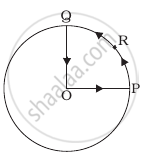
A cyclist starts from centre O of a circular park of radius 1 km and moves along the path OPRQO as shown figure. If he maintains constant speed of 10 ms–1, what is his acceleration at point R in magnitude and direction?
A small bead of mass m can move on a smooth circular wire (radius R) under the action of a force F = `"Km"/"r"^2` directed (r = position of bead r from P and K = constant) towards a point P within the circle at a distance R/2 from the centre. The minimum velocity should be ______ m/s of bead at the point of the wire nearest the centre of force (P) so that bead will complete the circle. (Take `"k"/(3"R")` = 8 unit)

The distance of the Sun from earth is 1.5 × 10¹¹ m and its angular diameter is (2000) s when observed from the earth. The diameter of the Sun will be ______.
The relationship between an object's linear velocity (v) and its angular velocity (ω) in a circular path of radius (r) is given by:
