Advertisements
Advertisements
प्रश्न
Name the force required for uniform circular motion. State its direction.
Advertisements
उत्तर
Force required for uniform circular motion is the centripetal force. It is directed towards its centre i.e., the centre of the circle.
संबंधित प्रश्न
Is it possible to have an accelerated motion with a constant speed? Explain
Draw a neat labelled diagram for a particle moving in a circular path with a constant speed. In you diagram show the direction of velocity at any instant.
Give an example of motion in which speed remains uniform, but the velocity changes.
A particle goes round a circular path with uniform speed v. After describing half the circle, what is the change in its centripetal acceleration?
A body of mass ·m' is moving along a circle of radius 'r' with linear speed 'v'. Now, to change the linear speed to `V/2` and to move it along the circle of radius '4r', required change in the centripetal force of the body is ______.
A ball of mass 'm' is attached to the free end of an inextensible string of length 'l'. Let 'T' be the tension in the string. The ball is moving in horizontal circular path about the vertical axis. The angular velocity of the ball at any particular instant will be ______.
Earth can be thought of as a sphere of radius 6400 km. Any object (or a person) is performing circular motion around the axis of earth due to earth’s rotation (period 1 day). What is acceleration of object on the surface of the earth (at equator) towards its centre? what is it at latitude θ? How does these accelerations compare with g = 9.8 m/s2?
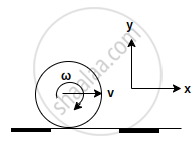
A disc of radius 5 cm rolls on a horizontal surface with linear velocity v = 1`hat"i"` m/s and angular velocity 50 rad/s. Height of particle from ground on rim of disc which has velocity in vertical direction is ______ cm.
A horizontal circular platform of mass M is rotating at angular velocity ω about a vertical axis passing through its centre. A boy of mass m is standing at the edge of the platform. If the boy comes to the centre of the platform, then the new angular velocity becomes ______.
What is the direction of the velocity of an object at any point during uniform circular motion?
