Advertisements
Advertisements
प्रश्न
Give an example of motion in which speed remains uniform, but the velocity changes.
Advertisements
उत्तर
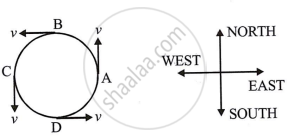
Direction of velocity in uniform circular motion
A particle travelling anticlockwise in a circular path with a constant speed v in a horizontal plane. The particle travels in the same amount of time (t = T/4) across each quarter of circles AB, BC, CD, and DA, where T is the particle's round-trip time on the circular path. Particle speed is therefore constant. However, at various places throughout the circular course, the particle's force direction of motion varies.
APPEARS IN
संबंधित प्रश्न
A stone tied to the end of a string 80 cm long is whirled in a horizontal circle with a constant speed. If the stone makes 14 revolutions in 25 s, what is the magnitude and direction of acceleration of the stone?
How does uniform circular motion differ from uniform linear motion?
State True or False
The earth moves around the sun with a uniform.
Which of the following quantity remains constant in uniform circular motion:
Define Uniform circular motion.
A flywheel at rest is to reach an angular velocity of 24 rad/s in 8 second with constant angular acceleration. The total angle turned through during this interval is ______.
A body moving along a circular path of radius R with velocity v, has centripetal acceleration a. If its velocity is made equal to 2v. What will be the centripetal acceleration?
A ceiling fan rotates about its own axis with some angular velocity. When the fan is switched off the angular velocity becomes `(1/4)^"th"` of the original in time 't' and 'n' revolutions are made in that time. The number of revolutions made by the fan during the time interval between switch off and rest are ______. (Angular retardation is uniform)
A simple pendulum of length l has maximum angular displacement θ. The maximum kinetic energy of the bob of mass m is ______.
(g = acceleration due to gravity)
Two bodies of masses 10 kg and 5 kg moving in concentric orbits of radii R and r such that their periods are the same. Then the ratio between their centripetal accelerations is ______.
