Advertisements
Advertisements
प्रश्न
Give an example of motion in which speed remains uniform, but the velocity changes.
Advertisements
उत्तर
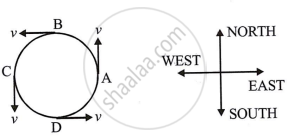
Direction of velocity in uniform circular motion
A particle travelling anticlockwise in a circular path with a constant speed v in a horizontal plane. The particle travels in the same amount of time (t = T/4) across each quarter of circles AB, BC, CD, and DA, where T is the particle's round-trip time on the circular path. Particle speed is therefore constant. However, at various places throughout the circular course, the particle's force direction of motion varies.
APPEARS IN
संबंधित प्रश्न
An aircraft executes a horizontal loop of radius 1.00 km with a steady speed of 900 km/h. Compare its centripetal acceleration with the acceleration due to gravity.
Is the uniform circular motion accelerated? Give reasons for your answer.
Select the WRONG statement.
At any instant, the magnitude of the centripetal force on a particle of mass 'm' performing circular motion is given by (ω = angular velocity and v = linear velocity of the particle) ______.
A particle is perfonning uniform circular motion. If 'θ', 'ω', 'α' and ' a' are its angular displacement, angular velocity, angular acceleration, and centripetal acceleration respectively, then which of the following is 'WRONG'?
The motion of the bus is ______ motion.
A point object moves along an arc of a circle of radius 'R'. Its velocity depends upon the distance covered 'S' as V = `Ksqrt(S)` where 'K' is a constant. If 'e' is the angle between the total acceleration and tangential acceleration, then
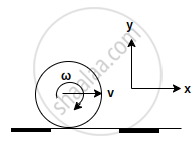
A disc of radius 5 cm rolls on a horizontal surface with linear velocity v = 1`hat"i"` m/s and angular velocity 50 rad/s. Height of particle from ground on rim of disc which has velocity in vertical direction is ______ cm.
A body of mass m is moving in circle of radius r with a constant speed v. The work done by the centripetal force in moving the body over half the circumference of the circle is ______.
In uniform circular motion, although the speed is constant, why does acceleration occur?
