Advertisements
Advertisements
Question
Give an example of motion in which speed remains uniform, but the velocity changes.
Advertisements
Solution
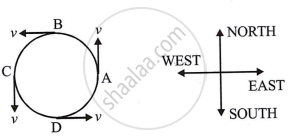
Direction of velocity in uniform circular motion
A particle travelling anticlockwise in a circular path with a constant speed v in a horizontal plane. The particle travels in the same amount of time (t = T/4) across each quarter of circles AB, BC, CD, and DA, where T is the particle's round-trip time on the circular path. Particle speed is therefore constant. However, at various places throughout the circular course, the particle's force direction of motion varies.
APPEARS IN
RELATED QUESTIONS
Is it possible to have an accelerated motion with a constant speed? Explain.
A particle performs uniform circular motion in a horizontal plane. The radius of the circle is 8 cm. The centripetal force acting on the particle is 15 N. Its kinetic energy is ____________.
A particle is moving in uniform circular motion with speed 'V' and radius 'R'. The angular acceleration of the particle is ______.
A cyclist is riding with a speed of 43.2 km/h. As he approaches a circular turn on the road of radius 60 m, he applies brakes and reduces his speed at constant rate of 1.8 ms-2. The magnitude of the net acceleration of the cyclist is ______.
The motion of the bus is ______ motion.
Define uniform circular motion and give an example of it. Why is it called accelerated motion?
If a body is moving in a circle of radius r with a constant speed v, its angular velocity is ______.
A wheel is rotating at 900 rpm about its axis. When the power is cut off it comes to rest in 1 min. The angular retardation (assumed to be uniform (in rad s-1) is ______.
The relationship between an object's linear velocity (v) and its angular velocity (ω) in a circular path of radius (r) is given by:
Angular displacement is measured in which unit?
