Advertisements
Advertisements
प्रश्न
A piece of stone tied at the end of a thread is whirled in a horizontal circle with uniform speed by hand. Answer the following questions:
- Is the velocity of stone uniform or variable?
- Is the acceleration of stone uniform or variable?
- What is the direction of acceleration of stone at any instant?
- Which force provides the centripetal force required for circular motion?
- Name the force and its direction which acts on the hand.
Advertisements
उत्तर
- The stone's velocity varies as it is thrown in a circular motion.
- The acceleration of stone is variable
- The direction of acceleration of stone is towards the centre of the circular path.
- Force of tension in the string provides the centripetal force required for circular motion.
- The reaction of tension is away from the centre of the circular path.
APPEARS IN
संबंधित प्रश्न
A particle rotates in U.C.M. with tangential velocity V along a horizontal circle of diameter ‘D' . Total angular displacement of the particle in time 't' is..........
Draw a neat labelled diagram of conical pendulum. State the expression for its periodic time in terms of length.
Is it possible to have an accelerated motion with a constant speed? Explain.
What is meant by uniform circular motion? Give two examples of uniform circular motion.
Select the WRONG statement.
A string of length `l` is fixed at one end and carries a mass 'm' at the other end. The mass is revolving along a horizontal circle of radius 'r' making 'θ' as the semi-vertical angle of cone and `(1/pi)` revolutions per second around the vertical axis through fixed end. The tension in the string is ______.
The given graph represents motion with ______ speed.
The motion of the bus is ______ motion.
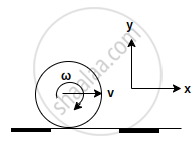
A disc of radius 5 cm rolls on a horizontal surface with linear velocity v = 1`hat"i"` m/s and angular velocity 50 rad/s. Height of particle from ground on rim of disc which has velocity in vertical direction is ______ cm.
A wheel is Subjected to uniform angular acceleration about its axis. Initially. its angular velocity is zero. In the first 2 s, it rotates through an angle θ1, in the next 2 s, it rotates through an angle θ2. The ratio of `theta_2/theta_1` is ______.
