Advertisements
Advertisements
प्रश्न
| A small pebble tied at one end of a string is placed near the periphery of a circular disc, at the centre of which the other end of the string is tied to a peg. The disc is rotating about an axis passing through its centre. |
- What will be your observation when you are standing outside the disc? Explain.
- What will be your observation when you are standing at the centre of the disc? Explain.
Advertisements
उत्तर
- On standing outside the disc, we find that the pebble is moving on a circular path.
- On standing at the centre of the disc, we find that the pebble is stationary, placed just in front of us.
APPEARS IN
संबंधित प्रश्न
Answer the following question.
Show that the centripetal force on a particle undergoing uniform circular motion is -mrω2.
A particle goes round a circular path with uniform speed v. After describing half the circle, what is the change in its centripetal acceleration?
The ratio of the angular speed of minute hand and hour hand of a watch is ____________.
At any instant, the magnitude of the centripetal force on a particle of mass 'm' performing circular motion is given by (ω = angular velocity and v = linear velocity of the particle) ______.
The motion of the bus is ______ motion.
Define uniform circular motion and give an example of it. Why is it called accelerated motion?
A point object moves along an arc of a circle of radius 'R'. Its velocity depends upon the distance covered 'S' as V = `Ksqrt(S)` where 'K' is a constant. If 'e' is the angle between the total acceleration and tangential acceleration, then
For a particle performing uniform circular motion, choose the correct statement(s) from the following:
- Magnitude of particle velocity (speed) remains constant.
- Particle velocity remains directed perpendicular to radius vector.
- Direction of acceleration keeps changing as particle moves.
- Angular momentum is constant in magnitude but direction keeps changing.
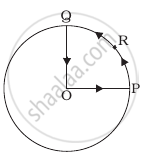
A cyclist starts from centre O of a circular park of radius 1 km and moves along the path OPRQO as shown figure. If he maintains constant speed of 10 ms–1, what is his acceleration at point R in magnitude and direction?
A ceiling fan rotates about its own axis with some angular velocity. When the fan is switched off the angular velocity becomes `(1/4)^"th"` of the original in time 't' and 'n' revolutions are made in that time. The number of revolutions made by the fan during the time interval between switch off and rest are ______. (Angular retardation is uniform)
