Advertisements
Advertisements
Question
| A small pebble tied at one end of a string is placed near the periphery of a circular disc, at the centre of which the other end of the string is tied to a peg. The disc is rotating about an axis passing through its centre. |
- What will be your observation when you are standing outside the disc? Explain.
- What will be your observation when you are standing at the centre of the disc? Explain.
Advertisements
Solution
- On standing outside the disc, we find that the pebble is moving on a circular path.
- On standing at the centre of the disc, we find that the pebble is stationary, placed just in front of us.
APPEARS IN
RELATED QUESTIONS
Complete a sentence and explain it.
When an object is in uniform circular motion, its ______ changes at every point.
Which of the following remains constant in a uniform circular motion, Speed or Velocity, or both?
Define angular velocity.
Which of the following graph represents uniform motion of a moving particle?
What is meant by uniform circular motion? Give two examples of uniform circular motion.
A body moves in a uniform circular motion ______.
A point object moves along an arc of a circle of radius 'R'. Its velocity depends upon the distance covered 'S' as V = `Ksqrt(S)` where 'K' is a constant. If 'e' is the angle between the total acceleration and tangential acceleration, then
For a particle performing uniform circular motion, choose the correct statement(s) from the following:
- Magnitude of particle velocity (speed) remains constant.
- Particle velocity remains directed perpendicular to radius vector.
- Direction of acceleration keeps changing as particle moves.
- Angular momentum is constant in magnitude but direction keeps changing.
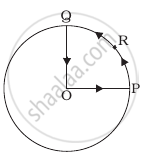
A cyclist starts from centre O of a circular park of radius 1 km and moves along the path OPRQO as shown figure. If he maintains constant speed of 10 ms–1, what is his acceleration at point R in magnitude and direction?
Why is uniform circular motion said to be accelerated?
