Advertisements
Advertisements
Questions
Differentiate between uniform linear motion and uniform circular motion.
State two differences between a body moving with a uniform linear motion and uniform circular motion.
Advertisements
Solution
| Sr. No. | Uniform linear motion | Uniform circular motion |
| 1. | The body moves along a straight line. | The body moves along a circular path. |
| 2. | There is no acceleration and a steady velocity and speed. | The velocity in uniform circular motion is variable. |
| 3. | It is not an accelerated motion. | It is an accelerated motion. |
RELATED QUESTIONS
For a particle performing uniform circular motion `vecv=vecomegaxxvecr`obtain an expression for linear acceleration of the particle performing non-uniform circular motion.
A vehicle is moving on a circular track whose surface is inclined towards the horizon at an angle of 10°. The maximum velocity with which it can move safely is 36 km / hr. Calculate the length of the circular track. [π = 3.142]
| A small pebble tied at one end of a string is placed near the periphery of a circular disc, at the centre of which the other end of the string is tied to a peg. The disc is rotating about an axis passing through its centre. |
- What will be your observation when you are standing outside the disc? Explain.
- What will be your observation when you are standing at the centre of the disc? Explain.
Define Uniform circular motion.
A small sphere is attached to a cord and rotates in a vertical circle about a point O. If the average speed of the sphere is increased, the cord is most likely to break at the orientation when the mass is at ____________.
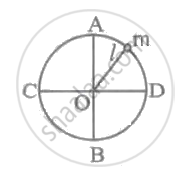
A particle performs uniform circular motion in a horizontal plane. The radius of the circle is 8 cm. The centripetal force acting on the particle is 15 N. Its kinetic energy is ____________.
At any instant, the magnitude of the centripetal force on a particle of mass 'm' performing circular motion is given by (ω = angular velocity and v = linear velocity of the particle) ______.
Which of the following is correct about uniform circular motion
- the direction of motion is continuously changed
- the direction of motion is not changed
- speed and direction both remain constant
- speed is constant but the direction is changing
A horizontal circular platform of mass M is rotating at angular velocity ω about a vertical axis passing through its centre. A boy of mass m is standing at the edge of the platform. If the boy comes to the centre of the platform, then the new angular velocity becomes ______.
The relationship between an object's linear velocity (v) and its angular velocity (ω) in a circular path of radius (r) is given by:
