Advertisements
Advertisements
Question
Answer the following question.
Show that its time period is given by, 2π`sqrt((l cos theta)/("g"))` where l is the length of the string, θ is the angle that the string makes with the vertical, and g is the acceleration due to gravity.
Advertisements
Solution
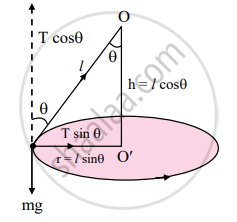
Conical pendulum
Where,
O: rigid support,
T: tension in the string,
l: length of string,
h: height of support from bob,
v: velocity of bob,
r: radius of horizontal circle,
θ: semi-vertical angle,
mg: weight of bob
- Consider a bob of mass m tied to one end of a string of length ‘l’ and the other end is fixed to a rigid support.
- Let the bob be displaced from its mean position and whirled around a horizontal circle of radius ‘r’ with constant angular velocity ω, then the bob performs U.C.M.
- During the motion, string is inclined to the vertical at an angle θ as shown in the figure above.
- In the displaced position, there are two forces acting on the bob.
a. The weight mg acting vertically downwards.
b. The tension T acting upward along the string. - The tension (T) acting in the string can be resolved into two components:
a. T cos θ acting vertically upwards.
b. T sin θ acting horizontally towards centre of the circle. - Since there is no net force, the vertical component T cos θ balances the weight and the horizontal component T sin θ provides the necessary centripetal force.
∴ T cos θ = mg ....(1)
T sin θ = `"mv"^2/"r" = "mr"omega^2` ....(2) - Dividing equation (2) by (1),
tan θ = `"v"^2/"rg"` ....(3)
Therefore, the angle made by the string with the vertical is θ = tan-1 `("v"^2/"rg")` - Since we know v = `(2pi"r")/"T"`
∴ tan θ = `(4pi^2"r"^2)/("T"^2"rg")` ....[From (3)]
T = `2pi sqrt("r"/("g"tan theta))`
T = `2pi sqrt((l sin theta)/("g"tan theta)) ....[because "r" = l sin theta]`
T = `2pi sqrt((l cos theta)/("g"))`
T = `2pi sqrt("h"/"g")` .....(∵ h = l cos θ)
where l is length of the pendulum and h is the vertical distance of the horizontal circle from the fixed point O.
APPEARS IN
RELATED QUESTIONS
A particle rotates in U.C.M. with tangential velocity V along a horizontal circle of diameter ‘D' . Total angular displacement of the particle in time 't' is..........
For a particle performing uniform circular motion `vecv=vecomegaxxvecr`obtain an expression for linear acceleration of the particle performing non-uniform circular motion.
Read the statement below carefully and state, with reason, if it is true or false:
The velocity vector of a particle at a point is always along the tangent to the path of the particle at that point.
Read the statement below carefully and state, with reason, if it is true or false:
The acceleration vector of a particle in uniform circular motion averaged over one cycle is a null vector.
Is it possible to have an accelerated motion with a constant speed? Explain
Earth moves around the sun with uniform velocity.
A uniform linear motion is unaccelerated, while a uniform circular motion is an accelerated motion.
In a uniform circular motion, the speed continuously changes because of the direction of motion changes.
Which of the following quantity remains constant in uniform circular motion:
Is the uniform circular motion accelerated? Give reasons for your answer.
The angle subtended by the vector A = `5hat"i" + 3hat"j" + 12hat"k"` with the X-axis is ______.
A uniform rod of length '6L' and mass '8 m' is pivoted at its centre 'C'. Two masses 'm' and ' 2m' with speed 2v, v as shown strikes the rod and stick to the rod. Initially the rod is at rest. Due to impact, if it rotates with angular velocity 'w1' then 'w' will be ________.

A small sphere is attached to a cord and rotates in a vertical circle about a point O. If the average speed of the sphere is increased, the cord is most likely to break at the orientation when the mass is at ____________.
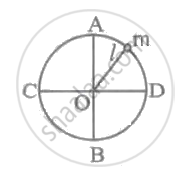
A particle of mass m is executing uniform circular motion on a path of radius r. If p is the magnitude of its linear momentum, the radial force acting on the particle is ______.
A wheel is 0.25 m in radius. When it makes 15 revolutions per minute, its linear speed at the point on circumference is ____________.
At any instant, the magnitude of the centripetal force on a particle of mass 'm' performing circular motion is given by (ω = angular velocity and v = linear velocity of the particle) ______.
Define uniform circular motion and give an example of it. Why is it called accelerated motion?
A body moving along a circular path of radius R with velocity v, has centripetal acceleration a. If its velocity is made equal to 2v. What will be the centripetal acceleration?
Earth can be thought of as a sphere of radius 6400 km. Any object (or a person) is performing circular motion around the axis of earth due to earth’s rotation (period 1 day). What is acceleration of object on the surface of the earth (at equator) towards its centre? what is it at latitude θ? How does these accelerations compare with g = 9.8 m/s2?
A particle is given an initial speed u inside a smooth spherical shell of radius R = 1 m that it is just able to complete the circle. Acceleration of the particle when its velocity is vertical is ______.

A wet open umbrella is held upright and is rotated about the handle at a uniform rate of 21 revolutions in 44 s. If the rim of the umbrella is a circle of 1 metre in diameter and the height of the rim above the floor is 1.5 m, the drops of water spun off the rim and hit the floor at a horizontal ______ m from the umbrella.
A rod PQ of mass M and length L is hinged at end P. The rod is kept horizontal by a massless string tied to point Q as shown in figure. When string is cut, the initial angular acceleration of the rod is ______.

A ceiling fan rotates about its own axis with some angular velocity. When the fan is switched off the angular velocity becomes `(1/4)^"th"` of the original in time 't' and 'n' revolutions are made in that time. The number of revolutions made by the fan during the time interval between switch off and rest are ______. (Angular retardation is uniform)
A body of mass m is moving in circle of radius r with a constant speed v. The work done by the centripetal force in moving the body over half the circumference of the circle is ______.
The kinetic energy K of a particle moving along a circle of radius R depends on the distance covered s as K = as2, where a is a constant. The force acting on the particle is ______.
In uniform circular motion, although the speed is constant, why does acceleration occur?
A particle moving with uniform speed in a circular path maintains ______.
