Advertisements
Advertisements
Question
A cyclist is riding with a speed of 27 km/h. As he approaches a circular turn on the road of radius 80 m, he applies brakes and reduces his speed at the constant rate of 0.50 m/s every second. What is the magnitude and direction of the net acceleration of the cyclist on the circular turn?
Advertisements
Solution 1
0.86 m/s2; 54.46° with the direction of velocity
Speed of the cyclist, v = 27 km/h = 7.5 m/s
Radius of the circular turn, r = 80 m
Centripetal acceleration is given as:
`a_c = v^2/r`
=(7.5)^2/80 = 0.7 `"m/s"^2`
The situation is shown in the given figure:
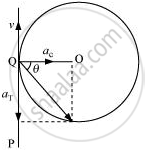
Suppose the cyclist begins cycling from point P and moves toward point Q. At point Q, he applies the breaks and decelerates the speed of the bicycle by 0.5 m/s2.
This acceleration is along the tangent at Q and opposite to the direction of motion of the cyclist.
Since the angle between`a_c` and `a_T`is 90°, the resultant acceleration a is given by:
a = `sqrt(a_c^2 + a_T^2)`
=`sqrt((0.7)^2 + (0.5)^2)`
=`sqrt(0.74) = 0.86` `"m/s"^2`
`tan theta = a_c/a_T`
Where `theta` is the angle of the resultant with the direction of velocity
`tan theta = 0.7/0.5 = 1.4`
`theta = tan^(-1)(1.4)`
`=54.46^@`
Solution 2
Here v = 27 km/h = `27xx5/18` m/s = 7.5 m/s, r = 80 m
and tangential acceleration `a_t = -0.50 "m/s"^2`
:.Centripetal acceleration `a_c = v^2/r = (7.5)^2/80 ms^2` (radially inwards)
Thus as shown in figure two accelerations are mutually perpendicular directions. If `veca` be the resultant acceleration then
|veca| = sqrt(a_t^2+a_c^2) = sqrt((0.5)^2+(0.7)^2) = 0.86 `ms^(-2)`
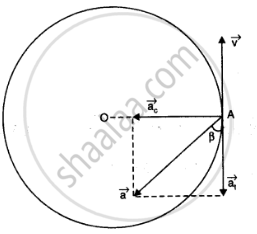
and tan beta = `a_c/a_t = 0.7/0.5 = 1.4`
`=> beta = tan^(-1) (1.4) = 54.5^@` fromthe direction of negative of the velocity
RELATED QUESTIONS
Draw a neat labelled diagram of conical pendulum. State the expression for its periodic time in terms of length.
A particle starts from the origin at t = 0 s with a velocity of 10.0 `hatj "m/s"` and moves in the x-y plane with a constant acceleration of `(8.0 hati + 2.0 hatj) ms^(-2)`.
- At what time is the x-coordinate of the particle 16 m? What is the y-coordinate of the particle at that time?
- What is the speed of the particle at the time?
A vehicle is moving on a circular track whose surface is inclined towards the horizon at an angle of 10°. The maximum velocity with which it can move safely is 36 km / hr. Calculate the length of the circular track. [π = 3.142]
How does uniform circular motion differ from uniform linear motion?
| A small pebble tied at one end of a string is placed near the periphery of a circular disc, at the centre of which the other end of the string is tied to a peg. The disc is rotating about an axis passing through its centre. |
- What will be your observation when you are standing outside the disc? Explain.
- What will be your observation when you are standing at the centre of the disc? Explain.
In a uniform circular motion, the speed continuously changes because of the direction of motion changes.
What is a conical pendulum?
Solve the following problem.
A particle moves in a circle with a constant speed of 15 m/s. The radius of the circle is 2 m. Determine the centripetal acceleration of the particle.
A particle goes round a circular path with uniform speed v. After describing half the circle, what is the change in its centripetal acceleration?
A particle performs uniform circular motion in a horizontal plane. The radius of the circle is 8 cm. The centripetal force acting on the particle is 15 N. Its kinetic energy is ____________.
Consider a simple pendulum of length 4 m. Its bob performs a circular motion in horizontal plane with its string making an angle 60° with the vertical. The Period of rotation of the bob is ____________.(Take g = 10 m/s2)
A cyclist is riding with a speed of 43.2 km/h. As he approaches a circular turn on the road of radius 60 m, he applies brakes and reduces his speed at constant rate of 1.8 ms-2. The magnitude of the net acceleration of the cyclist is ______.
Define uniform circular motion and give an example of it. Why is it called accelerated motion?
A flywheel at rest is to reach an angular velocity of 24 rad/s in 8 second with constant angular acceleration. The total angle turned through during this interval is ______.
If a body is moving in a circle of radius r with a constant speed v, its angular velocity is ______.
A wheel rotating at the same angular speed undergoes constant angular retardation. After the revolution, angular velocity reduces to half its initial value. It will make ______ revolution before stopping.
Angular speed of hour hand of a clock in degree per second is ______.
A particle is performing a uniform circular motion along a circle of radius R. In half the period of revolution, its displacement and distance covered are respectively.
The kinetic energy K of a particle moving along a circle of radius R depends on the distance covered s as K = as2, where a is a constant. The force acting on the particle is ______.
