Advertisements
Advertisements
प्रश्न
A cyclist is riding with a speed of 27 km/h. As he approaches a circular turn on the road of radius 80 m, he applies brakes and reduces his speed at the constant rate of 0.50 m/s every second. What is the magnitude and direction of the net acceleration of the cyclist on the circular turn?
Advertisements
उत्तर १
0.86 m/s2; 54.46° with the direction of velocity
Speed of the cyclist, v = 27 km/h = 7.5 m/s
Radius of the circular turn, r = 80 m
Centripetal acceleration is given as:
`a_c = v^2/r`
=(7.5)^2/80 = 0.7 `"m/s"^2`
The situation is shown in the given figure:
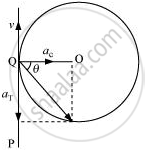
Suppose the cyclist begins cycling from point P and moves toward point Q. At point Q, he applies the breaks and decelerates the speed of the bicycle by 0.5 m/s2.
This acceleration is along the tangent at Q and opposite to the direction of motion of the cyclist.
Since the angle between`a_c` and `a_T`is 90°, the resultant acceleration a is given by:
a = `sqrt(a_c^2 + a_T^2)`
=`sqrt((0.7)^2 + (0.5)^2)`
=`sqrt(0.74) = 0.86` `"m/s"^2`
`tan theta = a_c/a_T`
Where `theta` is the angle of the resultant with the direction of velocity
`tan theta = 0.7/0.5 = 1.4`
`theta = tan^(-1)(1.4)`
`=54.46^@`
उत्तर २
Here v = 27 km/h = `27xx5/18` m/s = 7.5 m/s, r = 80 m
and tangential acceleration `a_t = -0.50 "m/s"^2`
:.Centripetal acceleration `a_c = v^2/r = (7.5)^2/80 ms^2` (radially inwards)
Thus as shown in figure two accelerations are mutually perpendicular directions. If `veca` be the resultant acceleration then
|veca| = sqrt(a_t^2+a_c^2) = sqrt((0.5)^2+(0.7)^2) = 0.86 `ms^(-2)`
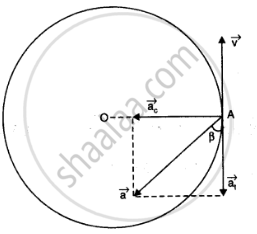
and tan beta = `a_c/a_t = 0.7/0.5 = 1.4`
`=> beta = tan^(-1) (1.4) = 54.5^@` fromthe direction of negative of the velocity
संबंधित प्रश्न
How does uniform circular motion differ from uniform linear motion?
Is it possible to have an accelerated motion with a constant speed? Name such type of motion.
| A small pebble tied at one end of a string is placed near the periphery of a circular disc, at the centre of which the other end of the string is tied to a peg. The disc is rotating about an axis passing through its centre. |
- What will be your observation when you are standing outside the disc? Explain.
- What will be your observation when you are standing at the centre of the disc? Explain.
Complete a sentence and explain it.
When an object is in uniform circular motion, its ______ changes at every point.
Which of the following quantity remains constant in a uniform circular motion?
Which of the following remains constant in a uniform circular motion, Speed or Velocity, or both?
Answer the following question.
Show that its time period is given by, 2π`sqrt((l cos theta)/("g"))` where l is the length of the string, θ is the angle that the string makes with the vertical, and g is the acceleration due to gravity.
Solve the following problem.
A particle moves in a circle with a constant speed of 15 m/s. The radius of the circle is 2 m. Determine the centripetal acceleration of the particle.
Solve the following problem.
A projectile is thrown at an angle of 30° to the horizontal. What should be the range of initial velocity (u) so that its range will be between 40m and 50 m? Assume g = 10 m s-2.
The angle subtended by the vector A = `5hat"i" + 3hat"j" + 12hat"k"` with the X-axis is ______.
If a particle moves with uniform speed then its tangential acceleration will be ______.
A particle is moving in uniform circular motion with speed 'V' and radius 'R'. The angular acceleration of the particle is ______.
Certain neutron stars are believed to be rotating at about 1 rev/s. If such a star has a radius of 1.6 km, the acceleration of an object on the equator of the star will be nearly ____________.
A cyclist is riding with a speed of 43.2 km/h. As he approaches a circular turn on the road of radius 60 m, he applies brakes and reduces his speed at constant rate of 1.8 ms-2. The magnitude of the net acceleration of the cyclist is ______.
A string of length `l` is fixed at one end and carries a mass 'm' at the other end. The mass is revolving along a horizontal circle of radius 'r' making 'θ' as the semi-vertical angle of cone and `(1/pi)` revolutions per second around the vertical axis through fixed end. The tension in the string is ______.
Define uniform circular motion and give an example of it. Why is it called accelerated motion?
If a body is moving in a circle of radius r with a constant speed v, its angular velocity is ______.
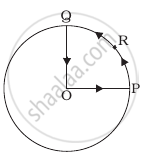
A cyclist starts from centre O of a circular park of radius 1 km and moves along the path OPRQO as shown figure. If he maintains constant speed of 10 ms–1, what is his acceleration at point R in magnitude and direction?
A simple pendulum of length l has maximum angular displacement θ. The maximum kinetic energy of the bob of mass m is ______.
(g = acceleration due to gravity)
A body of mass m is moving in circle of radius r with a constant speed v. The work done by the centripetal force in moving the body over half the circumference of the circle is ______.
