Advertisements
Advertisements
प्रश्न
A cyclist is riding with a speed of 27 km/h. As he approaches a circular turn on the road of radius 80 m, he applies brakes and reduces his speed at the constant rate of 0.50 m/s every second. What is the magnitude and direction of the net acceleration of the cyclist on the circular turn?
Advertisements
उत्तर १
0.86 m/s2; 54.46° with the direction of velocity
Speed of the cyclist, v = 27 km/h = 7.5 m/s
Radius of the circular turn, r = 80 m
Centripetal acceleration is given as:
`a_c = v^2/r`
=(7.5)^2/80 = 0.7 `"m/s"^2`
The situation is shown in the given figure:
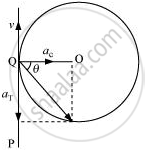
Suppose the cyclist begins cycling from point P and moves toward point Q. At point Q, he applies the breaks and decelerates the speed of the bicycle by 0.5 m/s2.
This acceleration is along the tangent at Q and opposite to the direction of motion of the cyclist.
Since the angle between`a_c` and `a_T`is 90°, the resultant acceleration a is given by:
a = `sqrt(a_c^2 + a_T^2)`
=`sqrt((0.7)^2 + (0.5)^2)`
=`sqrt(0.74) = 0.86` `"m/s"^2`
`tan theta = a_c/a_T`
Where `theta` is the angle of the resultant with the direction of velocity
`tan theta = 0.7/0.5 = 1.4`
`theta = tan^(-1)(1.4)`
`=54.46^@`
उत्तर २
Here v = 27 km/h = `27xx5/18` m/s = 7.5 m/s, r = 80 m
and tangential acceleration `a_t = -0.50 "m/s"^2`
:.Centripetal acceleration `a_c = v^2/r = (7.5)^2/80 ms^2` (radially inwards)
Thus as shown in figure two accelerations are mutually perpendicular directions. If `veca` be the resultant acceleration then
|veca| = sqrt(a_t^2+a_c^2) = sqrt((0.5)^2+(0.7)^2) = 0.86 `ms^(-2)`
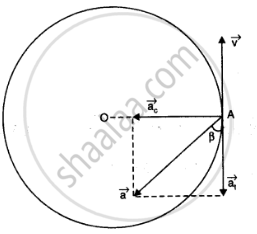
and tan beta = `a_c/a_t = 0.7/0.5 = 1.4`
`=> beta = tan^(-1) (1.4) = 54.5^@` fromthe direction of negative of the velocity
संबंधित प्रश्न
Read the statement below carefully and state, with reason, if it is true or false:
The acceleration vector of a particle in uniform circular motion averaged over one cycle is a null vector.
Is it possible to have an accelerated motion with a constant speed? Explain
A piece of stone tied at the end of a thread is whirled in a horizontal circle with uniform speed by hand. Answer the following questions:
- Is the velocity of stone uniform or variable?
- Is the acceleration of stone uniform or variable?
- What is the direction of acceleration of stone at any instant?
- Which force provides the centripetal force required for circular motion?
- Name the force and its direction which acts on the hand.
A uniform linear motion is unaccelerated, while a uniform circular motion is an accelerated motion.
In a uniform circular motion, the speed continuously changes because of the direction of motion changes.
Complete a sentence and explain it.
When an object is in uniform circular motion, its ______ changes at every point.
Is it possible to have an accelerated motion with a constant speed? Explain.
A particle goes round a circular path with uniform speed v. After describing half the circle, what is the change in its centripetal acceleration?
Certain neutron stars are believed to be rotating at about 1 rev/s. If such a star has a radius of 1.6 km, the acceleration of an object on the equator of the star will be nearly ____________.
Select the WRONG statement.
At any instant, the magnitude of the centripetal force on a particle of mass 'm' performing circular motion is given by (ω = angular velocity and v = linear velocity of the particle) ______.
A mass 'm' is tied to one end of a spring and whirled in a horizontal circle with constant angular velocity. The elongation in the spring is 1 cm. If the angular speed is doubled, the elongation in the spring is 6 cm. The original length of the spring is ______.
Which of the following is correct about uniform circular motion
- the direction of motion is continuously changed
- the direction of motion is not changed
- speed and direction both remain constant
- speed is constant but the direction is changing
A body is said to be in nonuniform motion if it travels ______.
A point object moves along an arc of a circle of radius 'R'. Its velocity depends upon the distance covered 'S' as V = `Ksqrt(S)` where 'K' is a constant. If 'e' is the angle between the total acceleration and tangential acceleration, then
A simple pendulum of length l has maximum angular displacement θ. The maximum kinetic energy of the bob of mass m is ______.
(g = acceleration due to gravity)
A wheel is rotating at 900 rpm about its axis. When the power is cut off it comes to rest in 1 min. The angular retardation (assumed to be uniform (in rad s-1) is ______.
The acceleration of a point on the rim of a flywheel 1 m in diameter, if it makes 1200 rpm is ______.
A wheel is Subjected to uniform angular acceleration about its axis. Initially. its angular velocity is zero. In the first 2 s, it rotates through an angle θ1, in the next 2 s, it rotates through an angle θ2. The ratio of `theta_2/theta_1` is ______.
The relationship between an object's linear velocity (v) and its angular velocity (ω) in a circular path of radius (r) is given by:
