Advertisements
Advertisements
प्रश्न
Answer the following question.
Show that its time period is given by, 2π`sqrt((l cos theta)/("g"))` where l is the length of the string, θ is the angle that the string makes with the vertical, and g is the acceleration due to gravity.
Advertisements
उत्तर
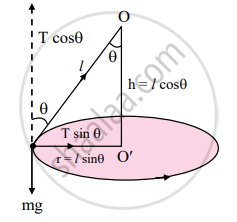
Conical pendulum
Where,
O: rigid support,
T: tension in the string,
l: length of string,
h: height of support from bob,
v: velocity of bob,
r: radius of horizontal circle,
θ: semi-vertical angle,
mg: weight of bob
- Consider a bob of mass m tied to one end of a string of length ‘l’ and the other end is fixed to a rigid support.
- Let the bob be displaced from its mean position and whirled around a horizontal circle of radius ‘r’ with constant angular velocity ω, then the bob performs U.C.M.
- During the motion, string is inclined to the vertical at an angle θ as shown in the figure above.
- In the displaced position, there are two forces acting on the bob.
a. The weight mg acting vertically downwards.
b. The tension T acting upward along the string. - The tension (T) acting in the string can be resolved into two components:
a. T cos θ acting vertically upwards.
b. T sin θ acting horizontally towards centre of the circle. - Since there is no net force, the vertical component T cos θ balances the weight and the horizontal component T sin θ provides the necessary centripetal force.
∴ T cos θ = mg ....(1)
T sin θ = `"mv"^2/"r" = "mr"omega^2` ....(2) - Dividing equation (2) by (1),
tan θ = `"v"^2/"rg"` ....(3)
Therefore, the angle made by the string with the vertical is θ = tan-1 `("v"^2/"rg")` - Since we know v = `(2pi"r")/"T"`
∴ tan θ = `(4pi^2"r"^2)/("T"^2"rg")` ....[From (3)]
T = `2pi sqrt("r"/("g"tan theta))`
T = `2pi sqrt((l sin theta)/("g"tan theta)) ....[because "r" = l sin theta]`
T = `2pi sqrt((l cos theta)/("g"))`
T = `2pi sqrt("h"/"g")` .....(∵ h = l cos θ)
where l is length of the pendulum and h is the vertical distance of the horizontal circle from the fixed point O.
APPEARS IN
संबंधित प्रश्न
Draw a neat labelled diagram of conical pendulum. State the expression for its periodic time in terms of length.
For a particle performing uniform circular motion `vecv=vecomegaxxvecr`obtain an expression for linear acceleration of the particle performing non-uniform circular motion.
A stone tied to the end of a string 80 cm long is whirled in a horizontal circle with a constant speed. If the stone makes 14 revolutions in 25 s, what is the magnitude and direction of acceleration of the stone?
A particle starts from the origin at t = 0 s with a velocity of 10.0 `hatj "m/s"` and moves in the x-y plane with a constant acceleration of `(8.0 hati + 2.0 hatj) ms^(-2)`.
- At what time is the x-coordinate of the particle 16 m? What is the y-coordinate of the particle at that time?
- What is the speed of the particle at the time?
Draw a neat labelled diagram for a particle moving in a circular path with a constant speed. In you diagram show the direction of velocity at any instant.
Differentiate between uniform linear motion and uniform circular motion.
A piece of stone tied at the end of a thread is whirled in a horizontal circle with uniform speed by hand. Answer the following questions:
- Is the velocity of stone uniform or variable?
- Is the acceleration of stone uniform or variable?
- What is the direction of acceleration of stone at any instant?
- Which force provides the centripetal force required for circular motion?
- Name the force and its direction which acts on the hand.
| A small pebble tied at one end of a string is placed near the periphery of a circular disc, at the centre of which the other end of the string is tied to a peg. The disc is rotating about an axis passing through its centre. |
- What will be your observation when you are standing outside the disc? Explain.
- What will be your observation when you are standing at the centre of the disc? Explain.
What is a conical pendulum?
Define angular velocity.
Answer the following question.
Show that the centripetal force on a particle undergoing uniform circular motion is -mrω2.
Solve the following problem.
A particle moves in a circle with a constant speed of 15 m/s. The radius of the circle is 2 m. Determine the centripetal acceleration of the particle.
The ratio of angular speed of a hour-hand to the second-hand of a watch is ____________.
The ratio of the angular speed of minute hand and hour hand of a watch is ____________.
A small sphere is attached to a cord and rotates in a vertical circle about a point O. If the average speed of the sphere is increased, the cord is most likely to break at the orientation when the mass is at ____________.
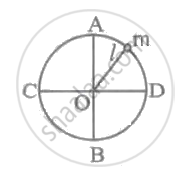
A particle of mass m is executing uniform circular motion on a path of radius r. If p is the magnitude of its linear momentum, the radial force acting on the particle is ______.
Two particles P and Q are moving in concentric circles of rarui rp and rQ respectively. If their period of revolutions are in ratio 2 : 3, then ratio of their centripetal acceleration is ____________.
A stone of mass 3 kg attached at one end of a 2m long string is whirled in horizontal circle. The string makes an angle of 45° with the vertical then the centripetal force acting on the string is ______.
(g = 10 m/s2 , tan 45° = 1)
A body moves in a uniform circular motion ______.
In uniform motion, an object travels equal ______ in ______ interval of time.
It is possible to have objects moving with uniform velocity but non-uniform acceleration.
A body moving along a circular path of radius R with velocity v, has centripetal acceleration a. If its velocity is made equal to 2v. What will be the centripetal acceleration?
If a body is moving in a circle of radius r with a constant speed v, its angular velocity is ______.
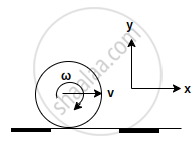
A disc of radius 5 cm rolls on a horizontal surface with linear velocity v = 1`hat"i"` m/s and angular velocity 50 rad/s. Height of particle from ground on rim of disc which has velocity in vertical direction is ______ cm.
The acceleration of a point on the rim of a flywheel 1 m in diameter, if it makes 1200 rpm is ______.
A body of mass m is moving in circle of radius r with a constant speed v. The work done by the centripetal force in moving the body over half the circumference of the circle is ______.
What is the direction of the velocity of an object at any point during uniform circular motion?
In uniform circular motion, although the speed is constant, why does acceleration occur?
What is the direction of the velocity of an object at any point during uniform circular motion?
The relationship between an object's linear velocity (v) and its angular velocity (ω) in a circular path of radius (r) is given by:
