Advertisements
Advertisements
प्रश्न
An aircraft executes a horizontal loop of radius 1.00 km with a steady speed of 900 km/h. Compare its centripetal acceleration with the acceleration due to gravity.
Advertisements
उत्तर
Radius of the loop, r = 1 km = 1000 m
Speed of the aircraft, `v = 900 "km/h" = 900 xx 5/18 = 250 "m/s"`
Centripetal acceleration, `a_c = v^2/r`
`=(250)^2/1000 = 62.5 "m/s"^2`
Acceleration due to gravity, g = 9.8 m/s2
`a_c/g = 62.5/9.8 = 6.38`
`a_c =6.38 g`
APPEARS IN
संबंधित प्रश्न
A cyclist is riding with a speed of 27 km/h. As he approaches a circular turn on the road of radius 80 m, he applies brakes and reduces his speed at the constant rate of 0.50 m/s every second. What is the magnitude and direction of the net acceleration of the cyclist on the circular turn?
How does uniform circular motion differ from uniform linear motion?
Draw a neat labelled diagram for a particle moving in a circular path with a constant speed. In you diagram show the direction of velocity at any instant.
Differentiate between uniform linear motion and uniform circular motion.
The motion of the moon around the earth in a circular path is an accelerated motion.
Name the force required for uniform circular motion. State its direction.
Answer the following question.
Show that the centripetal force on a particle undergoing uniform circular motion is -mrω2.
Solve the following problem.
A projectile is thrown at an angle of 30° to the horizontal. What should be the range of initial velocity (u) so that its range will be between 40m and 50 m? Assume g = 10 m s-2.
What is meant by uniform circular motion? Give two examples of uniform circular motion.
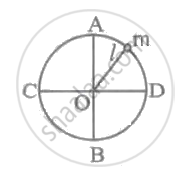
A small sphere is attached to a cord and rotates in a vertical circle about a point O. If the average speed of the sphere is increased, the cord is most likely to break at the orientation when the mass is at ____________.
A wheel is 0.25 m in radius. When it makes 15 revolutions per minute, its linear speed at the point on circumference is ____________.
A stone of mass 3 kg attached at one end of a 2m long string is whirled in horizontal circle. The string makes an angle of 45° with the vertical then the centripetal force acting on the string is ______.
(g = 10 m/s2 , tan 45° = 1)
Which of the following is correct about uniform circular motion
- the direction of motion is continuously changed
- the direction of motion is not changed
- speed and direction both remain constant
- speed is constant but the direction is changing
Define uniform circular motion and give an example of it. Why is it called accelerated motion?
A body moving along a circular path of radius R with velocity v, has centripetal acceleration a. If its velocity is made equal to 2v. What will be the centripetal acceleration?
If a body is moving in a circle of radius r with a constant speed v, its angular velocity is ______.
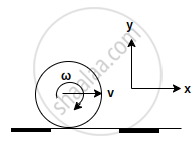
A disc of radius 5 cm rolls on a horizontal surface with linear velocity v = 1`hat"i"` m/s and angular velocity 50 rad/s. Height of particle from ground on rim of disc which has velocity in vertical direction is ______ cm.
A body of mass m is moving in circle of radius r with a constant speed v. The work done by the centripetal force in moving the body over half the circumference of the circle is ______.
Explain the meaning of uniform circular motion.
What is the direction of the velocity of an object at any point during uniform circular motion?
