Advertisements
Advertisements
प्रश्न
Draw a neat labelled diagram of conical pendulum. State the expression for its periodic time in terms of length.
Advertisements
उत्तर
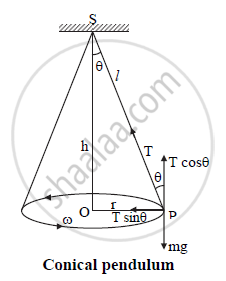
Where, S: rigid support
T : tension in the string
l : length of string
h : height of support from bob
v : velocity of bob
r : radius of horizontal circle
θ: semi-vertical angle
mg : weight of bob
i) Consider a bob of mass m tied to one
end of a string of length ‘l’ and other
the end is fixed to a rigid support.
ii) Let the bob be displaced from its mean
position and whirled around a
horizontal circle of radius ‘r’ with
constant angular velocity ω, then the
bob performs U.C.M.
iii) During the motion, a string is inclined to
the vertical at an angle θ as shown in
the above figure.
iv) In the displaced position P, there are two
forces acting on the bob.
a. The weight mg acting vertically
downwards.
b. The tension T acting upward
along the string.
v) The tension (T) acting in the string can
be resolved into two components:
a. T cos θ acting vertically upwards.
b. T sin θ acting horizontally towards
centre of the circle.
vi) Vertical component T cos θ balances the
weight and horizontal component T sin θ
provides the necessary centripetal force.
∴ T cos θ = mg . ........(1)
T sin θ = `"mv"^2/"r" = "mr"omega^2` ....(2)
vii) Dividing equation (2) by (1),
tan θ = `"v"^2/"rg"` ......(3)
Therefore, the angle made by the string with the vertical is θ = `tan^-1 ("v"^2/"rg")`
Also, from equation (3),
v2 = rg tan θ
∴ v = `sqrt ("rg" tan theta)`
The period, T = `(2pi"r")/"v" = (2pi"r")/sqrt("rg" "tan" theta) = 2pi sqrt ("r"/("g tan" theta))`
It can be seen that r - = l sin θ
T = `2pi sqrt (("l sin" theta)/("g tan" theta)) = 2pi sqrt (("l cos" theta)/"g")`
The period of a conical pendulum is `2pi sqrt (("l cos" theta)/"g")`
APPEARS IN
संबंधित प्रश्न
Earth moves around the sun with uniform velocity.
Draw a neat labelled diagram for a particle moving in a circular path with a constant speed. In you diagram show the direction of velocity at any instant.
A uniform circular motion is an accelerated motion. Explain it. State whether the acceleration is uniform or variable? Name the force responsible to cause this acceleration. What is the direction of force at any instant? Draw a diagram in support of your answer.
Differentiate between uniform linear motion and uniform circular motion.
In a uniform circular motion, the speed continuously changes because of the direction of motion changes.
Complete a sentence and explain it.
When an object is in uniform circular motion, its ______ changes at every point.
Solve the following problem.
A particle moves in a circle with a constant speed of 15 m/s. The radius of the circle is 2 m. Determine the centripetal acceleration of the particle.
Which one of the following is most likely not a case of uniform circular motion?
What is meant by uniform circular motion? Give two examples of uniform circular motion.
The angle subtended by the vector A = `5hat"i" + 3hat"j" + 12hat"k"` with the X-axis is ______.
A uniform rod of length '6L' and mass '8 m' is pivoted at its centre 'C'. Two masses 'm' and ' 2m' with speed 2v, v as shown strikes the rod and stick to the rod. Initially the rod is at rest. Due to impact, if it rotates with angular velocity 'w1' then 'w' will be ________.

The ratio of the angular speed of minute hand and hour hand of a watch is ____________.
A particle is moving in uniform circular motion with speed 'V' and radius 'R'. The angular acceleration of the particle is ______.
A disc has mass 'M' and radius 'R'. How much tangential force should be applied to the rim of the disc, so as to rotate with angular velocity 'ω' in time t?
The angular speed of the minute hand of a clock in degrees per second is ______.
A cyclist is riding with a speed of 43.2 km/h. As he approaches a circular turn on the road of radius 60 m, he applies brakes and reduces his speed at constant rate of 1.8 ms-2. The magnitude of the net acceleration of the cyclist is ______.
Statement A: Uniform circular motion is a case of accelerated motion
Statement B: In the third equation of motion we do not have the term time
In uniform motion, an object travels equal ______ in ______ interval of time.
A point object moves along an arc of a circle of radius 'R'. Its velocity depends upon the distance covered 'S' as V = `Ksqrt(S)` where 'K' is a constant. If 'e' is the angle between the total acceleration and tangential acceleration, then
For a particle performing uniform circular motion, choose the correct statement(s) from the following:
- Magnitude of particle velocity (speed) remains constant.
- Particle velocity remains directed perpendicular to radius vector.
- Direction of acceleration keeps changing as particle moves.
- Angular momentum is constant in magnitude but direction keeps changing.
Earth also moves in circular orbit around sun once every year with on orbital radius of 1.5 × 10¹¹ m. What is the acceleration of earth (or any object on the surface of the earth) towards the centre of the sun? How does this acceleration compare with g = 9.8 m/s2?
A wheel rotating at the same angular speed undergoes constant angular retardation. After the revolution, angular velocity reduces to half its initial value. It will make ______ revolution before stopping.
A horizontal circular platform of mass M is rotating at angular velocity ω about a vertical axis passing through its centre. A boy of mass m is standing at the edge of the platform. If the boy comes to the centre of the platform, then the new angular velocity becomes ______.
A thin uniform circular disc of mass M and radius R is rotating in a horizontal plane about an axis passing through its centre and perpendicular to its plane with an angular velocity ω. Another disc of same dimensions, but of mass `1/4`M is placed gently on the first disc co-axially. The. angular velocity of the system is ______.
Explain the meaning of uniform circular motion.
The relationship between an object's linear velocity (v) and its angular velocity (ω) in a circular path of radius (r) is given by:
What is the direction of the velocity of an object at any point during uniform circular motion?
