Advertisements
Advertisements
प्रश्न
Is it possible to have an accelerated motion with a constant speed? Explain.
Advertisements
उत्तर
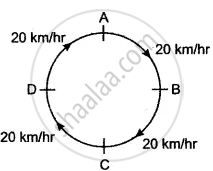
Yes, it is possible to have accelerated motion with constant speed, when a body is moving in a circular path. The body changes its path so there is a change in direction (velocity) but its speed remains the same.
संबंधित प्रश्न
A particle rotates in U.C.M. with tangential velocity V along a horizontal circle of diameter ‘D' . Total angular displacement of the particle in time 't' is..........
A stone tied to the end of a string 80 cm long is whirled in a horizontal circle with a constant speed. If the stone makes 14 revolutions in 25 s, what is the magnitude and direction of acceleration of the stone?
Explain the meaning of uniform circular motion. Give one example of such motion.
Which of the following quantity remains constant in a uniform circular motion?
Is the uniform circular motion accelerated? Give reasons for your answer.
A small sphere is attached to a cord and rotates in a vertical circle about a point O. If the average speed of the sphere is increased, the cord is most likely to break at the orientation when the mass is at ____________.
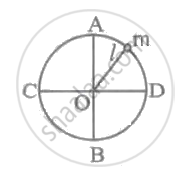
Consider a simple pendulum of length 4 m. Its bob performs a circular motion in horizontal plane with its string making an angle 60° with the vertical. The Period of rotation of the bob is ____________.(Take g = 10 m/s2)
Angular speed of hour hand of a clock in degree per second is ______.
The kinetic energy K of a particle moving along a circle of radius R depends on the distance covered s as K = as2, where a is a constant. The force acting on the particle is ______.
Angular displacement is measured in which unit?
