Advertisements
Advertisements
प्रश्न
Is it possible to have an accelerated motion with a constant speed? Explain.
Advertisements
उत्तर
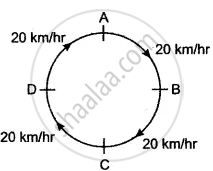
Yes, it is possible to have accelerated motion with constant speed, when a body is moving in a circular path. The body changes its path so there is a change in direction (velocity) but its speed remains the same.
संबंधित प्रश्न
Draw a neat labelled diagram of conical pendulum. State the expression for its periodic time in terms of length.
Draw a neat labelled diagram for a particle moving in a circular path with a constant speed. In you diagram show the direction of velocity at any instant.
The angle subtended by the vector A = `5hat"i" + 3hat"j" + 12hat"k"` with the X-axis is ______.
A particle performs uniform circular motion in a horizontal plane. The radius of the circle is 8 cm. The centripetal force acting on the particle is 15 N. Its kinetic energy is ____________.
A wheel is 0.25 m in radius. When it makes 15 revolutions per minute, its linear speed at the point on circumference is ____________.
A ball of mass 'm' is attached to the free end of an inextensible string of length 'l'. Let 'T' be the tension in the string. The ball is moving in horizontal circular path about the vertical axis. The angular velocity of the ball at any particular instant will be ______.
Earth also moves in circular orbit around sun once every year with on orbital radius of 1.5 × 10¹¹ m. What is the acceleration of earth (or any object on the surface of the earth) towards the centre of the sun? How does this acceleration compare with g = 9.8 m/s2?
A particle is given an initial speed u inside a smooth spherical shell of radius R = 1 m that it is just able to complete the circle. Acceleration of the particle when its velocity is vertical is ______.

The relationship between an object's linear velocity (v) and its angular velocity (ω) in a circular path of radius (r) is given by:
By applying Kepler's third law to the formula for centripetal force, Newton concluded that the force acting on a planet is:
