Advertisements
Advertisements
प्रश्न
Draw a neat labelled diagram of conical pendulum. State the expression for its periodic time in terms of length.
Advertisements
उत्तर
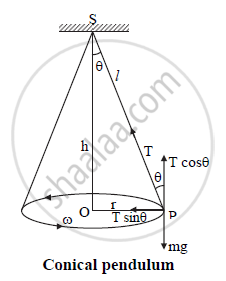
Where, S: rigid support
T : tension in the string
l : length of string
h : height of support from bob
v : velocity of bob
r : radius of horizontal circle
θ: semi-vertical angle
mg : weight of bob
i) Consider a bob of mass m tied to one
end of a string of length ‘l’ and other
the end is fixed to a rigid support.
ii) Let the bob be displaced from its mean
position and whirled around a
horizontal circle of radius ‘r’ with
constant angular velocity ω, then the
bob performs U.C.M.
iii) During the motion, a string is inclined to
the vertical at an angle θ as shown in
the above figure.
iv) In the displaced position P, there are two
forces acting on the bob.
a. The weight mg acting vertically
downwards.
b. The tension T acting upward
along the string.
v) The tension (T) acting in the string can
be resolved into two components:
a. T cos θ acting vertically upwards.
b. T sin θ acting horizontally towards
centre of the circle.
vi) Vertical component T cos θ balances the
weight and horizontal component T sin θ
provides the necessary centripetal force.
∴ T cos θ = mg . ........(1)
T sin θ = `"mv"^2/"r" = "mr"omega^2` ....(2)
vii) Dividing equation (2) by (1),
tan θ = `"v"^2/"rg"` ......(3)
Therefore, the angle made by the string with the vertical is θ = `tan^-1 ("v"^2/"rg")`
Also, from equation (3),
v2 = rg tan θ
∴ v = `sqrt ("rg" tan theta)`
The period, T = `(2pi"r")/"v" = (2pi"r")/sqrt("rg" "tan" theta) = 2pi sqrt ("r"/("g tan" theta))`
It can be seen that r - = l sin θ
T = `2pi sqrt (("l sin" theta)/("g tan" theta)) = 2pi sqrt (("l cos" theta)/"g")`
The period of a conical pendulum is `2pi sqrt (("l cos" theta)/"g")`
APPEARS IN
संबंधित प्रश्न
A vehicle is moving on a circular track whose surface is inclined towards the horizon at an angle of 10°. The maximum velocity with which it can move safely is 36 km / hr. Calculate the length of the circular track. [π = 3.142]
Explain the meaning of uniform circular motion. Give one example of such motion.
In a uniform circular motion, the speed continuously changes because of the direction of motion changes.
Which of the following quantity remains constant in a uniform circular motion?
Name the force required for uniform circular motion. State its direction.
Solve the following problem.
A projectile is thrown at an angle of 30° to the horizontal. What should be the range of initial velocity (u) so that its range will be between 40m and 50 m? Assume g = 10 m s-2.
What is meant by uniform circular motion? Give two examples of uniform circular motion.
The angle subtended by the vector A = `5hat"i" + 3hat"j" + 12hat"k"` with the X-axis is ______.
The ratio of the angular speed of minute hand and hour hand of a watch is ____________.
A particle of mass m is executing uniform circular motion on a path of radius r. If p is the magnitude of its linear momentum, the radial force acting on the particle is ______.
A disc has mass 'M' and radius 'R'. How much tangential force should be applied to the rim of the disc, so as to rotate with angular velocity 'ω' in time t?
At any instant, the magnitude of the centripetal force on a particle of mass 'm' performing circular motion is given by (ω = angular velocity and v = linear velocity of the particle) ______.
A ball of mass 'm' is attached to the free end of an inextensible string of length 'l'. Let 'T' be the tension in the string. The ball is moving in horizontal circular path about the vertical axis. The angular velocity of the ball at any particular instant will be ______.
A mass 'm' is tied to one end of a spring and whirled in a horizontal circle with constant angular velocity. The elongation in the spring is 1 cm. If the angular speed is doubled, the elongation in the spring is 6 cm. The original length of the spring is ______.
Two particles P and Q are moving in concentric circles of rarui rp and rQ respectively. If their period of revolutions are in ratio 2 : 3, then ratio of their centripetal acceleration is ____________.
A body is said to be in nonuniform motion if it travels ______.
A body moving along a circular path of radius R with velocity v, has centripetal acceleration a. If its velocity is made equal to 2v. What will be the centripetal acceleration?
For a particle performing uniform circular motion, choose the correct statement(s) from the following:
- Magnitude of particle velocity (speed) remains constant.
- Particle velocity remains directed perpendicular to radius vector.
- Direction of acceleration keeps changing as particle moves.
- Angular momentum is constant in magnitude but direction keeps changing.
Earth can be thought of as a sphere of radius 6400 km. Any object (or a person) is performing circular motion around the axis of earth due to earth’s rotation (period 1 day). What is acceleration of object on the surface of the earth (at equator) towards its centre? what is it at latitude θ? How does these accelerations compare with g = 9.8 m/s2?
A ceiling fan rotates about its own axis with some angular velocity. When the fan is switched off the angular velocity becomes `(1/4)^"th"` of the original in time 't' and 'n' revolutions are made in that time. The number of revolutions made by the fan during the time interval between switch off and rest are ______. (Angular retardation is uniform)
A particle is performing a uniform circular motion along a circle of radius R. In half the period of revolution, its displacement and distance covered are respectively.
A wheel is rotating at 900 rpm about its axis. When the power is cut off it comes to rest in 1 min. The angular retardation (assumed to be uniform (in rad s-1) is ______.
The acceleration of a point on the rim of a flywheel 1 m in diameter, if it makes 1200 rpm is ______.
The kinetic energy K of a particle moving along a circle of radius R depends on the distance covered s as K = as2, where a is a constant. The force acting on the particle is ______.
The relationship between an object's linear velocity (v) and its angular velocity (ω) in a circular path of radius (r) is given by:
The relationship between an object's linear velocity (v) and its angular velocity (ω) in a circular path of radius (r) is given by:
