Advertisements
Advertisements
प्रश्न
Earth also moves in circular orbit around sun once every year with on orbital radius of 1.5 × 10¹¹ m. What is the acceleration of earth (or any object on the surface of the earth) towards the centre of the sun? How does this acceleration compare with g = 9.8 m/s2?
Advertisements
उत्तर
The orbital radius of the earth around the sun (R) = 1.5 × 10¹¹ m
Time period = 1 yr = 365 day
= 365 × 24 × 60 × 60 s
= 3.15 ×10⁷ s
Centripetal acceleration `(a_c) = Rω^2 = (5pi^2R)/T^2`
= `(4 xx (22/7)^2 xx 1.5 xx 10^11)/(3.15 xx 10^7)^2`
= `5.97 xx 10^-3` m/s2
∴ `a_c/g = (5.97 xx 10^-3)/9.8 = 1/1642`
APPEARS IN
संबंधित प्रश्न
How does uniform circular motion differ from uniform linear motion?
Earth moves around the sun with uniform velocity.
Which of the following remains constant in a uniform circular motion, Speed or Velocity, or both?
Answer the following question.
Show that the centripetal force on a particle undergoing uniform circular motion is -mrω2.
Which one of the following is most likely not a case of uniform circular motion?
If a particle moves with uniform speed then its tangential acceleration will be ______.
A particle performs uniform circular motion in a horizontal plane. The radius of the circle is 8 cm. The centripetal force acting on the particle is 15 N. Its kinetic energy is ____________.
Certain neutron stars are believed to be rotating at about 1 rev/s. If such a star has a radius of 1.6 km, the acceleration of an object on the equator of the star will be nearly ____________.
The given graph represents motion with ______ speed.
Which of the following is correct about uniform circular motion
- the direction of motion is continuously changed
- the direction of motion is not changed
- speed and direction both remain constant
- speed is constant but the direction is changing
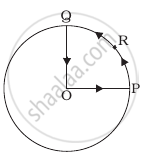
A cyclist starts from centre O of a circular park of radius 1 km and moves along the path OPRQO as shown figure. If he maintains constant speed of 10 ms–1, what is his acceleration at point R in magnitude and direction?
A particle is performing a uniform circular motion along a circle of radius R. In half the period of revolution, its displacement and distance covered are respectively.
A wheel is rotating at 900 rpm about its axis. When the power is cut off it comes to rest in 1 min. The angular retardation (assumed to be uniform (in rad s-1) is ______.
A thin uniform circular disc of mass M and radius R is rotating in a horizontal plane about an axis passing through its centre and perpendicular to its plane with an angular velocity ω. Another disc of same dimensions, but of mass `1/4`M is placed gently on the first disc co-axially. The. angular velocity of the system is ______.
Why is uniform circular motion said to be accelerated?
The relationship between an object's linear velocity (v) and its angular velocity (ω) in a circular path of radius (r) is given by:
By applying Kepler's third law to the formula for centripetal force, Newton concluded that the force acting on a planet is:
A particle moving with uniform speed in a circular path maintains ______.
