Advertisements
Advertisements
प्रश्न
Solve the following problem.
A particle moves in a circle with a constant speed of 15 m/s. The radius of the circle is 2 m. Determine the centripetal acceleration of the particle.
Advertisements
उत्तर
Given: v = 15 m/s, r = 2m
To find: Centripetal acceleration (a)
Formulae: a = `"v"^2/"r"`
Calculation: From formula,
a = `(15)^2/2 = 225/2`
∴ a = 112.5 m/s2
The centripetal acceleration of the particle is 112.5 m/s2.
APPEARS IN
संबंधित प्रश्न
In U. C. M (Uniform Circular Motion), prove the relation `vec v = vec w xx vec r`, where symbols have their usual meanings.
Draw a neat labelled diagram of conical pendulum. State the expression for its periodic time in terms of length.
Read the statement below carefully and state, with reason, if it is true or false:
The velocity vector of a particle at a point is always along the tangent to the path of the particle at that point.
Draw a neat labelled diagram for a particle moving in a circular path with a constant speed. In you diagram show the direction of velocity at any instant.
Is it possible to have an accelerated motion with a constant speed? Name such type of motion.
| A small pebble tied at one end of a string is placed near the periphery of a circular disc, at the centre of which the other end of the string is tied to a peg. The disc is rotating about an axis passing through its centre. |
- What will be your observation when you are standing outside the disc? Explain.
- What will be your observation when you are standing at the centre of the disc? Explain.
In a uniform circular motion, the speed continuously changes because of the direction of motion changes.
Which of the following quantity remains constant in a uniform circular motion?
Name the force required for uniform circular motion. State its direction.
Define Uniform circular motion.
Is it possible to have an accelerated motion with a constant speed? Explain.
Solve the following problem.
A car moves in a circle at a constant speed of 50 m/s and completes one revolution in 40 s. Determine the magnitude of the acceleration of the car.
The ratio of the angular speed of minute hand and hour hand of a watch is ____________.
A small sphere is attached to a cord and rotates in a vertical circle about a point O. If the average speed of the sphere is increased, the cord is most likely to break at the orientation when the mass is at ____________.
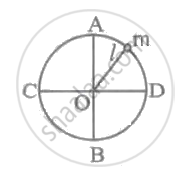
Consider a simple pendulum of length 4 m. Its bob performs a circular motion in horizontal plane with its string making an angle 60° with the vertical. The Period of rotation of the bob is ____________.(Take g = 10 m/s2)
A wheel is 0.25 m in radius. When it makes 15 revolutions per minute, its linear speed at the point on circumference is ____________.
A mass 'm' is tied to one end of a spring and whirled in a horizontal circle with constant angular velocity. The elongation in the spring is 1 cm. If the angular speed is doubled, the elongation in the spring is 6 cm. The original length of the spring is ______.
It is possible to have objects moving with uniform velocity but non-uniform acceleration.
A flywheel at rest is to reach an angular velocity of 24 rad/s in 8 second with constant angular acceleration. The total angle turned through during this interval is ______.
A body moving along a circular path of radius R with velocity v, has centripetal acceleration a. If its velocity is made equal to 2v. What will be the centripetal acceleration?
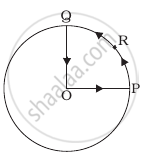
A cyclist starts from centre O of a circular park of radius 1 km and moves along the path OPRQO as shown figure. If he maintains constant speed of 10 ms–1, what is his acceleration at point R in magnitude and direction?
A particle is given an initial speed u inside a smooth spherical shell of radius R = 1 m that it is just able to complete the circle. Acceleration of the particle when its velocity is vertical is ______.

A ceiling fan rotates about its own axis with some angular velocity. When the fan is switched off the angular velocity becomes `(1/4)^"th"` of the original in time 't' and 'n' revolutions are made in that time. The number of revolutions made by the fan during the time interval between switch off and rest are ______. (Angular retardation is uniform)
A particle moves along a circle of radius r with constant tangential acceleration. If the velocity of the particle is v at the end of second revolution, after the revolution has started, then the tangential acceleration is ______.
Two bodies of masses 10 kg and 5 kg moving in concentric orbits of radii R and r such that their periods are the same. Then the ratio between their centripetal accelerations is ______.
A thin uniform circular disc of mass M and radius R is rotating in a horizontal plane about an axis passing through its centre and perpendicular to its plane with an angular velocity ω. Another disc of same dimensions, but of mass `1/4`M is placed gently on the first disc co-axially. The. angular velocity of the system is ______.
In uniform circular motion, although the speed is constant, why does acceleration occur?
What is the direction of the velocity of an object at any point during uniform circular motion?
The relationship between an object's linear velocity (v) and its angular velocity (ω) in a circular path of radius (r) is given by:
