Advertisements
Advertisements
प्रश्न
Define Uniform circular motion.
Advertisements
उत्तर
When a particle moves with a constant speed in a circular path, its motion is said to be the uniform circular motion.
संबंधित प्रश्न
Explain the meaning of uniform circular motion. Give one example of such motion.
Which of the following quantity remains constant in uniform circular motion:
Which one of the following is most likely not a case of uniform circular motion?
A small sphere is attached to a cord and rotates in a vertical circle about a point O. If the average speed of the sphere is increased, the cord is most likely to break at the orientation when the mass is at ____________.
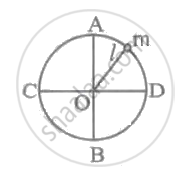
A particle performs uniform circular motion in a horizontal plane. The radius of the circle is 8 cm. The centripetal force acting on the particle is 15 N. Its kinetic energy is ____________.
Earth also moves in circular orbit around sun once every year with on orbital radius of 1.5 × 10¹¹ m. What is the acceleration of earth (or any object on the surface of the earth) towards the centre of the sun? How does this acceleration compare with g = 9.8 m/s2?
A particle moves along a circle of radius r with constant tangential acceleration. If the velocity of the particle is v at the end of second revolution, after the revolution has started, then the tangential acceleration is ______.
Angular speed of hour hand of a clock in degree per second is ______.
Two bodies of masses 10 kg and 5 kg moving in concentric orbits of radii R and r such that their periods are the same. Then the ratio between their centripetal accelerations is ______.
The kinetic energy K of a particle moving along a circle of radius R depends on the distance covered s as K = as2, where a is a constant. The force acting on the particle is ______.
