Advertisements
Advertisements
प्रश्न
In U. C. M (Uniform Circular Motion), prove the relation `vec v = vec w xx vec r`, where symbols have their usual meanings.
Advertisements
उत्तर
Analytical method :
Consider a particle revolving in the anticlockwise sense along the circumference of a circle of radius r with centre O as shown.
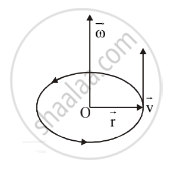
Let
`vec omega`= angular velocity of the particle
`vec v`= linear velocity of the particle
`vec r`= radius of the particle
In the vector form, the linear dispalcement is
`vec (delta s) = vec (delta theta) times vec r`
Dividing both sides by `delta t` we get
`vec (delta s)/(delta t) = vec (delta theta)/(delta t) times vec r`
`lim_(delta t -> 0) vec (delta s)/(delta t) = lim_(delta t -> 0) vec (delta theta)/(delta t) times vec r`
`therefore vec(dS)/dt = vec(d theta)/(delta t) times vec r`
but
`vec(dS)/dt = vec v` = Linear velocity
`vec(d theta)/(delta t) = vec omega` = angular velocity
`therefore vec v = vec omega times vec r`
APPEARS IN
संबंधित प्रश्न
Draw a neat labelled diagram of conical pendulum. State the expression for its periodic time in terms of length.
An aircraft executes a horizontal loop of radius 1.00 km with a steady speed of 900 km/h. Compare its centripetal acceleration with the acceleration due to gravity.
A particle starts from the origin at t = 0 s with a velocity of 10.0 `hatj "m/s"` and moves in the x-y plane with a constant acceleration of `(8.0 hati + 2.0 hatj) ms^(-2)`.
- At what time is the x-coordinate of the particle 16 m? What is the y-coordinate of the particle at that time?
- What is the speed of the particle at the time?
Why is the motion of a body moving with a constant speed around a circular path said to be accelerated?
Earth moves around the sun with uniform velocity.
Give an example of motion in which speed remains uniform, but the velocity changes.
Complete a sentence and explain it.
When an object is in uniform circular motion, its ______ changes at every point.
Which of the following quantity remains constant in a uniform circular motion?
A uniform metre rule of mass 100g is balanced on a fulcrum at mark 40cm by suspending an unknown mass m at the mark 20cm.
To which side the rule will tilt if the mass m is moved to the mark 10cm ?
Define Uniform circular motion.
Answer the following question.
Show that its time period is given by, 2π`sqrt((l cos theta)/("g"))` where l is the length of the string, θ is the angle that the string makes with the vertical, and g is the acceleration due to gravity.
Define angular velocity.
Solve the following problem.
A projectile is thrown at an angle of 30° to the horizontal. What should be the range of initial velocity (u) so that its range will be between 40m and 50 m? Assume g = 10 m s-2.
Is the uniform circular motion accelerated? Give reasons for your answer.
What is meant by uniform circular motion? Give two examples of uniform circular motion.
If a particle moves with uniform speed then its tangential acceleration will be ______.
A particle is moving in uniform circular motion with speed 'V' and radius 'R'. The angular acceleration of the particle is ______.
The angular speed of the minute hand of a clock in degrees per second is ______.
Statement A: Uniform circular motion is a case of accelerated motion
Statement B: In the third equation of motion we do not have the term time
It is possible to have objects moving with uniform velocity but non-uniform acceleration.
A point object moves along an arc of a circle of radius 'R'. Its velocity depends upon the distance covered 'S' as V = `Ksqrt(S)` where 'K' is a constant. If 'e' is the angle between the total acceleration and tangential acceleration, then
Earth can be thought of as a sphere of radius 6400 km. Any object (or a person) is performing circular motion around the axis of earth due to earth’s rotation (period 1 day). What is acceleration of object on the surface of the earth (at equator) towards its centre? what is it at latitude θ? How does these accelerations compare with g = 9.8 m/s2?
A particle is given an initial speed u inside a smooth spherical shell of radius R = 1 m that it is just able to complete the circle. Acceleration of the particle when its velocity is vertical is ______.

A disc of radius 5 cm rolls on a horizontal surface with linear velocity v = 1`hat"i"` m/s and angular velocity 50 rad/s. Height of particle from ground on rim of disc which has velocity in vertical direction is ______ cm.
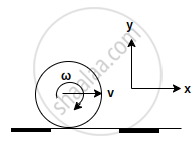
A wheel rotating at the same angular speed undergoes constant angular retardation. After the revolution, angular velocity reduces to half its initial value. It will make ______ revolution before stopping.
A particle moves along a circle of radius r with constant tangential acceleration. If the velocity of the particle is v at the end of second revolution, after the revolution has started, then the tangential acceleration is ______.
In uniform circular motion, although the speed is constant, why does acceleration occur?
Angular displacement is measured in which unit?
