Advertisements
Advertisements
प्रश्न
A particle starts from the origin at t = 0 s with a velocity of 10.0 `hatj "m/s"` and moves in the x-y plane with a constant acceleration of `(8.0 hati + 2.0 hatj) ms^(-2)`.
- At what time is the x-coordinate of the particle 16 m? What is the y-coordinate of the particle at that time?
- What is the speed of the particle at the time?
Advertisements
उत्तर १
Velocity of the particle `vecv = 10.0 hatj` m/s
Acceleration of the particle = `veca = (8.0 hati + 2.0 hatj)`
Also
But `veca = (dvecv)/(dt) = 8.0 hati +2.0 hatj`
`(dvecv) = (8.0 hati + 2.0 hatj)dt`
Integrating both sides:
`vecv(t)= 8.0t hati + 2.0t hatj + vecu`
where
`vecu` = velocity vector of the particle at t= 0
`vecv` = velocity vector of the particle at time t
But `vecv = (dvecr)/(dt)`
`dvecr = vecvdt = (8.0t hati + 2.0t hatj + vecu)dt`
Integrating the equations with the conditions: at t = 0; r = 0 andat t = t; r = r
`vecr = vecut + 1/28.0t^2 hati + 1/2xx2.0t^2 hatj`
`=vecut + 4.0t^2 hati + t^2 hatj`
`=(10.0 hatj)t + 4.0t^2 hati + t^2 hatj`
`x hati + y hatj = 4.0t^2 hati + (10t + t^2)hatj`
Since the motion of the particle is confined to the x-y plane, on equating the coefficients of `hati "and" hatj`, we get:
`x = 4t^2`
`t = (x/4)^(1/2)`
And `y = 10t + t^2`
(a) When x = 16 m
`t=(16/4)^(1/2)= 2s`
∴ y = 10 × 2 + (2)2 = 24 m
(b) Velocity of the particle is given by:
`vecv(t) = 8.0t hati + 2.0t hatj + hatu`
at t = 2s
`vecv(t) = 8.0 xx 2 hati + 2.0 xx 2 hatj + 10 hatj`
=`16 hati+ 14 hatj`
∴Speed of the particle
`|vecv| = sqrt((16)^2 + (14)^2)`
`=sqrt(256+196) = sqrt(452)`
`= 21.26 "m/s"`
उत्तर २
it is given that `vecr_(t = 0s) = vecv_(0) = 10.0 hatj` m/s and `veca(t) = (8.0 hati + 2.0 hatj) ms^(-2)`
(a) it means `x_0 = 0,u_x = 0, a_x = 8.0` `ms^(-2)` and x = 16 m
Using relation `s = x - x_0 = u_xt+1/2a_xt^2` we have
`16 - 0 = 0 + 1/2 xx 8.0 xx t^2 => t = 2s`
`:.y = y_0 + u_yt+ 1/2a_yt^2 = 0 + 10.0xx2+1/2xx2.0xx(2)^2`
= 20 + 4 = 24 m
(b) Velocity of particle at t= 2 s along x-axis
`v_x = u_x+a_xt=0 + 8.0 xx 2 = 16.0` m/s
and along y-axis `v_y = u_y+a_yt = 10.0 + 2.0 xx 2 = 14.0` m/s
∴Speed of particle at t = 2s
`v= sqrt(v_x^2+v_y^2) = sqrt((16.0)^2+(14.0)^2) = 21.26 ms^(-1)`
APPEARS IN
संबंधित प्रश्न
In U. C. M (Uniform Circular Motion), prove the relation `vec v = vec w xx vec r`, where symbols have their usual meanings.
A particle rotates in U.C.M. with tangential velocity V along a horizontal circle of diameter ‘D' . Total angular displacement of the particle in time 't' is..........
Give an example of motion in which speed remains uniform, but the velocity changes.
Answer the following question.
Show that its time period is given by, 2π`sqrt((l cos theta)/("g"))` where l is the length of the string, θ is the angle that the string makes with the vertical, and g is the acceleration due to gravity.
Define angular velocity.
Solve the following problem.
A particle moves in a circle with a constant speed of 15 m/s. The radius of the circle is 2 m. Determine the centripetal acceleration of the particle.
The angle subtended by the vector A = `5hat"i" + 3hat"j" + 12hat"k"` with the X-axis is ______.
A particle is perfonning uniform circular motion. If 'θ', 'ω', 'α' and ' a' are its angular displacement, angular velocity, angular acceleration, and centripetal acceleration respectively, then which of the following is 'WRONG'?
A ball of mass 'm' is attached to the free end of an inextensible string of length 'l'. Let 'T' be the tension in the string. The ball is moving in horizontal circular path about the vertical axis. The angular velocity of the ball at any particular instant will be ______.
A cyclist is riding with a speed of 43.2 km/h. As he approaches a circular turn on the road of radius 60 m, he applies brakes and reduces his speed at constant rate of 1.8 ms-2. The magnitude of the net acceleration of the cyclist is ______.
A point object moves along an arc of a circle of radius 'R'. Its velocity depends upon the distance covered 'S' as V = `Ksqrt(S)` where 'K' is a constant. If 'e' is the angle between the total acceleration and tangential acceleration, then
Earth also moves in circular orbit around sun once every year with on orbital radius of 1.5 × 10¹¹ m. What is the acceleration of earth (or any object on the surface of the earth) towards the centre of the sun? How does this acceleration compare with g = 9.8 m/s2?
A small bead of mass m can move on a smooth circular wire (radius R) under the action of a force F = `"Km"/"r"^2` directed (r = position of bead r from P and K = constant) towards a point P within the circle at a distance R/2 from the centre. The minimum velocity should be ______ m/s of bead at the point of the wire nearest the centre of force (P) so that bead will complete the circle. (Take `"k"/(3"R")` = 8 unit)

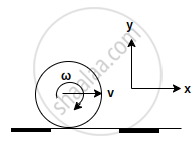
A disc of radius 5 cm rolls on a horizontal surface with linear velocity v = 1`hat"i"` m/s and angular velocity 50 rad/s. Height of particle from ground on rim of disc which has velocity in vertical direction is ______ cm.
A wet open umbrella is held upright and is rotated about the handle at a uniform rate of 21 revolutions in 44 s. If the rim of the umbrella is a circle of 1 metre in diameter and the height of the rim above the floor is 1.5 m, the drops of water spun off the rim and hit the floor at a horizontal ______ m from the umbrella.
The distance of the Sun from earth is 1.5 × 10¹¹ m and its angular diameter is (2000) s when observed from the earth. The diameter of the Sun will be ______.
A particle moves along a circle of radius r with constant tangential acceleration. If the velocity of the particle is v at the end of second revolution, after the revolution has started, then the tangential acceleration is ______.
The acceleration of a point on the rim of a flywheel 1 m in diameter, if it makes 1200 rpm is ______.
A wheel is Subjected to uniform angular acceleration about its axis. Initially. its angular velocity is zero. In the first 2 s, it rotates through an angle θ1, in the next 2 s, it rotates through an angle θ2. The ratio of `theta_2/theta_1` is ______.
A particle moving with uniform speed in a circular path maintains ______.
