Advertisements
Advertisements
प्रश्न
A jack screw is provided with a long arm. Explain why?
Explain the following:
A jack screw is provided with long arm.
Advertisements
उत्तर
A force is supplied at a position on the body where the distance from the axis is maximum in order to maximise the screw jack's turning effect. In order to give the screw jack the highest torque possible given the supplied force. The formula for the turning effect of the body is moment of force (torque) = force applied × perpendicular distance of force from the axis of rotation.
As a result, the jack screw may apply more force the longer its arm.
संबंधित प्रश्न
A nut is opened by a wrench of length 20 cm. If the least force required is 2N, find the moment of force needed to loosen the nut.
Moment of force = force × perpendicular distance of force – from the pivoted point.
What is thrust?
State one way to obtain greater moment of a given force about a given axis of rotation.
A rocket is moving at a constant speed in space by burning its fuel and ejecting out the burnt gases through a nozzle. Answer the following
1) Is there any change in the momentum of the rocket? if yes, what causes the change in momentum?
2) Is there any force acting on the rocket? if yes, how much?
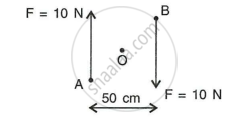
The figure shows two forces each of magnitude 10 N acting at the point A and B at a separation of 50 cm, in opposite directions. Calculate the resultant moment of two forces about the point.
- A,
- B and
- O situated exactly at the middle of the two forces.
Define non-contact forces.
How does the distance of separation between two bodies affect the magnitude of the non-contact force between them?
Two similar vehicles are moving with the same velocity on the road, such that one of thus is loaded and the other one is empty which of the two vehicles will require larger force to stop?
The diagram shows wheel O pivoted at point A. Three equal forces F1, F2 and F3 act at point B on the wheel.

- Which force will produce maximum moment about A?
- Give a reason for your answer in (a).
