Advertisements
Advertisements
प्रश्न
A faulty balance of unequal arms and pans of unequal weights is used to find the true weight of a metal. By double weighing the weights are found to be 1210 g and 1000 g. Calculate the true weight of the metal.
Advertisements
उत्तर
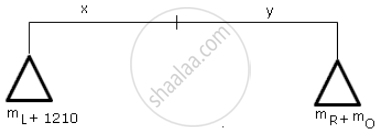

(mL + 1210) x = (mR + mo) y ..............(1)
(mL + m0) x = (mR + 1000) y .............(2)
mL x = mR y ..............(3)
Equations when the two pans are empty from (1)
mL x + 1210 x = mR y + mo y
⇒ 1210 x = mo y ...............(4) (using 3)
from (2)
mL + mo x = mR + 1000 y
⇒ mo x = 1000 y ................(5) (using 3)
dividing equation (4) & (5)
`"m"_"o"/1000 = 1210/"m"_"o"`
⇒ mO = `sqrt (1210 xx1000)` = 1100 g
APPEARS IN
संबंधित प्रश्न
What do you mean by an equilibrium of a body?
State the condition when a body is in dynamic equilibrium.
State two condition for a body acted upon by several forces to be in equilibrium.
The moon revolving around the earth is in ______ equilibrium.
State the principle of moments.
Define the term momentum.
What is a couple?
When a stone tied to a string is rotated in a horizontal plane, the tension in the string provides ______ force necessary for circular motion.
