Advertisements
Advertisements
प्रश्न
A uniform meter scale is in equilibrium as shown in the diagram :
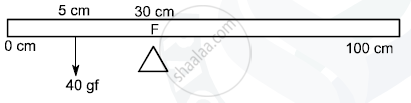
(i) Calculate the weight of the meter scale.
(ii) Which of the following options is correct to keep the ruler in equilibrium when 40 gf wt is shifted to 0 cm mark ?
F is shifted towards 0 cm
or
F is shifted towards 100 cm
Advertisements
उत्तर
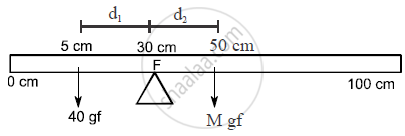
(i) Mass of the meter scale wiil be concentrated at its centre
∴ At 50 cm, Mass of meter scale = M gf
`therefore F_1d_1= F_2 d_2`
`(25) = F_2(20)`
50 gf = F2
0.49N = F2
∴ F2 = m (9.8)
`=(0.49)/(9.8)= m`
∴ m = 0.05kg
1m = 500m
(ii) F is shifted towards 0 cm.
APPEARS IN
संबंधित प्रश्न
In a beam balance, when the beam is balanced in a horizontal position, it is in ______ equilibrium.
State the condition when a body is in static equilibrium.
State the condition when a body is in dynamic equilibrium.
State two condition for a body acted upon by several forces to be in equilibrium.
A meter scale is pivoted at its mid point and a 50 g mass suspended from the 20 cm mark. What mass balances the ruler when suspended from 65 cm mark?
Give scientific reason for the following:
While climbing a hill you will try to bend your body forward.
A faulty balance of unequal arms and pans of unequal weights is used to find the true weight of a metal. By double weighing the weights are found to be 1210 g and 1000 g. Calculate the true weight of the metal.
In equilibrium algebraic sum of moments of all forces about the point of rotation is ______.
