Advertisements
Advertisements
Question
A uniform meter scale is in equilibrium as shown in the diagram :
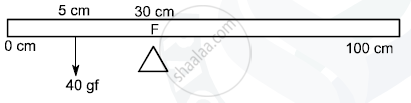
(i) Calculate the weight of the meter scale.
(ii) Which of the following options is correct to keep the ruler in equilibrium when 40 gf wt is shifted to 0 cm mark ?
F is shifted towards 0 cm
or
F is shifted towards 100 cm
Advertisements
Solution
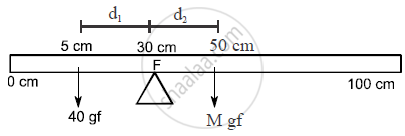
(i) Mass of the meter scale wiil be concentrated at its centre
∴ At 50 cm, Mass of meter scale = M gf
`therefore F_1d_1= F_2 d_2`
`(25) = F_2(20)`
50 gf = F2
0.49N = F2
∴ F2 = m (9.8)
`=(0.49)/(9.8)= m`
∴ m = 0.05kg
1m = 500m
(ii) F is shifted towards 0 cm.
APPEARS IN
RELATED QUESTIONS
Define equilibrium.
State the condition when a body is in static equilibrium.
State the condition when a body is in dynamic equilibrium.
Give scientific reason for the following:
In a moving bus the standing passenger stands keeping both his legs apart.
A faulty balance of unequal arms and pans of unequal weights is used to find the true weight of a metal. By double weighing the weights are found to be 1210 g and 1000 g. Calculate the true weight of the metal.
Explain why It is easier to knock down a boy who is standing on one foot than one who is standing on two.
Explain when we carry weight, on one hand, we bend on the other side.
What is the weight of a body placed at the centre of the earth?
Give an experiment to verify the principle of moments.
Explain the concept which is used in the continuous movement of the Thanjavur doll?
