Advertisements
Advertisements
Question
A faulty balance of unequal arms and pans of unequal weights is used to find the true weight of a metal. By double weighing the weights are found to be 1210 g and 1000 g. Calculate the true weight of the metal.
Advertisements
Solution
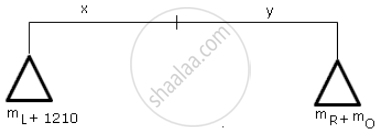

(mL + 1210) x = (mR + mo) y ..............(1)
(mL + m0) x = (mR + 1000) y .............(2)
mL x = mR y ..............(3)
Equations when the two pans are empty from (1)
mL x + 1210 x = mR y + mo y
⇒ 1210 x = mo y ...............(4) (using 3)
from (2)
mL + mo x = mR + 1000 y
⇒ mo x = 1000 y ................(5) (using 3)
dividing equation (4) & (5)
`"m"_"o"/1000 = 1210/"m"_"o"`
⇒ mO = `sqrt (1210 xx1000)` = 1100 g
APPEARS IN
RELATED QUESTIONS
State the condition when a body is in static equilibrium.
The figure shows a uniform metre rule placed on a fulcrum at its mid-point O and having a weight 40 gf at the 10 cm mark and a weight of 20 gf at the 90 cm mark.
- Is the metre rule in equilibrium? If not how will the rule turn?
- How can the rule be brought in equilibrium by using an additional weight of 40 gf?

In equilibrium algebraic sum of moments of all forces about the point of rotation is ______.
Explain when we carry weight, on one hand, we bend on the other side.
What is meant by equilibrium?
What do you mean by static equilibrium? Give one example.
One end of a spring is kept fixed while the other end is stretched by a force as shown in the diagram.

(i) Copy the diagram and mark on it the direction of the restoring force.
(ii) Name one instrument which works on the above principle.
Give an experiment to verify the principle of moments.
How can we increase the stability of an object?
When a stone tied to a string is rotated in a horizontal plane, the tension in the string provides ______ force necessary for circular motion.
