Advertisements
Advertisements
Question
State the principle of moments. A meter scale is pivoted at 30 cm mark and it is in equilibrium when a mass of 40 g is suspended from 10 cm mark. Calculate the mass of the ruler.
Advertisements
Solution
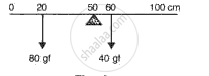
Let the mass of 50 g be situated at distance 'd' from the mid-point i.e. at 50cm,
80 x 30 = (40 x 10) + (50 x d)
2400 = 400 + 50d
or 50d = 2000
or d = 40cm to the right of the mid-point.
RELATED QUESTIONS
State the condition when a body is in dynamic equilibrium.
State the principle of moments. Give one device as an application of it
What do you mean by the state of equilibrium? What are the conditions for stable equilibrium?
A meter scale is pivoted at its mid point and a 50 g mass suspended from the 20 cm mark. What mass balances the ruler when suspended from 65 cm mark?
Give scientific reason for the following:
When a man climbs a slope he bends forward.
In equilibrium algebraic sum of moments of all forces about the point of rotation is ______.
What do you mean by static equilibrium? Give one example.
Give an experiment to verify the principle of moments.
When a stone tied to a string is rotated in a horizontal plane, the tension in the string provides ______ force necessary for circular motion.
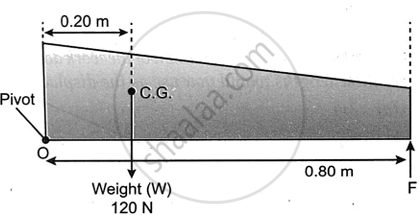
A non uniform beam of weight 120 N pivoted at one end is shown in the diagram below. Calculate the value of F to keep the beam in equilibrium.