Advertisements
Advertisements
Question
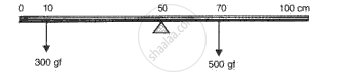
Fig. 5 shows a uniform meter scale weighing 200 gf. Provided at its centre. Two weights 300 gf and 500 gf are suspended from the ruler as shown in the diagram. Calculate the resultant torque of the ruler and hence calculate the distance from mid-point where a 100 gf should be suspended to balance the meter scale.
Advertisements
Solution
Resultant torque = sum of clockwise moments - sum of anticlockwise moments
Taking, moments about the mid point
Resulttant torque = (300 x 40) - (500 x 20)
or, Resultant torque = 12000 - 10000 = 2000 gf-cm
Let a mass of 100 gf be suspended at a distance 'd' from the mid point towards the right side,
so as to balance the metre scale.
Then, in balanced condition:
sum of clockwise moments = sum of anticlockwise moments
(300 x 40) = (500 x 20) + (100 x d)
or, 12000 = 10000 + 100d
or, 100d = 2000
or,d = 20cm to the right of the mid-point
APPEARS IN
RELATED QUESTIONS
A brass ball is hanging from a stiff cotton thread. Draw a neat labeled diagram showing the forces acting on the brass ball and cotton thread
Thrust is the ............ force acting on a surface.
State the relationship between force, mass and acceleration. Draw graphs showing the relationship between Acceleration and mass for a constant force.
The stone of hand flour grinder is provided with a handle near its rim. Give reason.
The moment of a force about axis depends ______.
A nut is opened by a wrench of length 10 cm. if the least force required is 5.0 N. find the moment of force needed to turn the nut.
Give an example of the following uses of a machine:
to change the direction of force
Two unlike forces (parallel) of 10 N and 25 N act at a distance of 12 cm. from each other. Find the point about which the body balance.

A metal rod AB of length 80 cm is balanced at 45 cm from the end A with 100 gf weights suspended from the two ends.
- If this rod is cut at the center, C, then compare the weight of AC to the weight of BC. (Use >, < or =)
- Give a reason for your answer in (a).
The diagram in Fig shows two forces F1 = 5 N and F2 = 3 N acting at points A and B respectively of a rod pivoted at a point O, such that OA = 2 m and OB = 4 m.
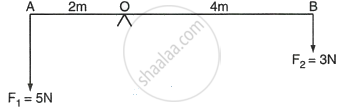
Calculate:
- the moment of force F1 about O.
- the moment of force F2 about O.
- total moment of the two forces about O.
