Advertisements
Advertisements
Question
How does the effect of force differ when it is applied on a rigid body?
Advertisements
Solution
When a force applied on a rigid object it does not change the interspacing of constituent molecules and does not change dimensions and can cause motion in it.
APPEARS IN
RELATED QUESTIONS
Name the factors affecting the turning effect of a body
Less force is needed when applied at a farther distance from the pivoted point.
State Newton's third law of motion.
Define couple.
(i) What do you understand by the term couple of forces?
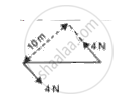
(ii) Calculate the moment of a couple shown in fig.
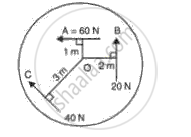
Three forces A, B and C are acting on a rigid body which can turn about O in fig.9. If all the three forces are applied simultaneously, in which direction will the body move? Explain.
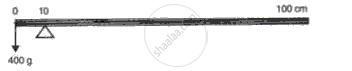
A meter scale is provided at 10 cm mark and is balanced by suspending 400 g from 0 cm mark (fig.). Calculate the mass of meter scale.
State whether the moment of force is a scalar or vector quantity?
How does the distance of separation between two bodies affect the magnitude of the non-contact force between them?
Calculate the magnitude of the force of a couple, when the arm of the couple is 63 cm and the moment of the couple is 21 Nm.
