Advertisements
Advertisements
Question
State two effects of a force when applied on a body.
Advertisements
Solution 1
Two effects of applied force:
- It can change the state of body.
i.e. It can stop a moving object and also a force can move a stationary object. - A force can change the shape (and size) of an object.
Solution 2
-
Change in Motion:
- A force can make a stationary body move or change the speed and direction of a moving body.
- Example: Pushing a stationary car causes it to start moving.
-
Change in Shape or Size:
- A force can deform an object, altering its shape or size.
- Example: Squeezing a rubber ball changes its shape temporarily.
APPEARS IN
RELATED QUESTIONS
A force always produces both the linear and turning motions.
State two factors on which affect moment of force.
Name and define the S.I. and C.G.S. units of force. How are they related?
A car of mass 600 kg is moving with a speed of 10 ms-1 while a scooter of mass 80 kg us moving with a speed of 50 ms-1. Compare their momentum.
A uniform metre scale can be balanced at the 70.0 cm mark when a mark when a mass 0.05 kg is hung from the 94.0 cm mark
- draw a diagram of the arrangement
- Find the mass of the metre scale
Define couple.
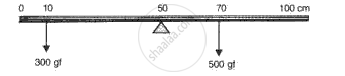
Fig. 5 shows a uniform meter scale weighing 200 gf. Provided at its centre. Two weights 300 gf and 500 gf are suspended from the ruler as shown in the diagram. Calculate the resultant torque of the ruler and hence calculate the distance from mid-point where a 100 gf should be suspended to balance the meter scale.
Define non-contact forces.
The perpendicular distance between the point of application of force and turning point is 1.75 m when a force of 80 N acts on a rigid body. Calculate the moment of force.
