Advertisements
Advertisements
प्रश्न
State two effects of a force when applied on a body.
Advertisements
उत्तर १
Two effects of applied force:
- It can change the state of body.
i.e. It can stop a moving object and also a force can move a stationary object. - A force can change the shape (and size) of an object.
उत्तर २
-
Change in Motion:
- A force can make a stationary body move or change the speed and direction of a moving body.
- Example: Pushing a stationary car causes it to start moving.
-
Change in Shape or Size:
- A force can deform an object, altering its shape or size.
- Example: Squeezing a rubber ball changes its shape temporarily.
APPEARS IN
संबंधित प्रश्न
A brass ball is hanging from a stiff cotton thread. Draw a neat labeled diagram showing the forces acting on the brass ball and cotton thread
A force is applied on (i) a non-rigid body and (ii) a rigid body. How does the effect of the force differ in the above two cases?
Match the column
| Column A | Column B |
| (a) Camel | (1) broad and deep foundation |
| (b) Truck | (2) broad feet |
| (c) Knife | (3) six or eight tyres |
| (d) High building | (4) sharp cutting edge |
| (e) Thrust | (5) atm |
| (f) Moment of force | (6) N |
| (g) Atmospheric pressure | (7) N m |
The spanner (or wrench) has a long handle.
State Newton's third law of motion.
State two factor on which moment of force about a point depends.
Classify the following amongst contact and non-contact forces.
Frictional force
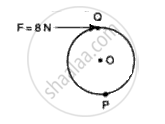
A wheel of diameter 3 m is shown in fig. 2 with axle at 0. A force F = 8 N is applied at Q in the direction shown in figure. Calculate the moment of force about:
(i) centre o, and
(ii) point p.
State two factors on which moment of the force about a point depends.
Two unlike forces (parallel) of 10 N and 25 N act at a distance of 12 cm. from each other. Find the point about which the body balance.
