Advertisements
Advertisements
Question
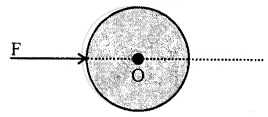
In Fig. a force F is applied in a direction passing through the pivoted point O of the body. Will the body rotate? Give reason to support your answer.
Advertisements
Solution
No, the body will not rotate as
Turning effect = Force × perpendicular distance of the force from the pivoted point.
= F × 0 = 0
perpendicular distance = 0 or force is parallel to the point of application of force.
APPEARS IN
RELATED QUESTIONS
An effort is applied on the bigger wheel of a gear having 32 teeth. It is used to turn a wheel of 8 teeth. Where it is used.
A half metre rod is pivoted at the centre with two weights of 20gf and 12gf suspended at a perpendicular distance of 6 cm and 10 cm from the pivot respectively as shown below.
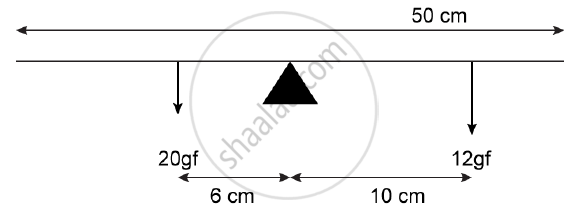
1) Which of the two forces acting on the rigid rod causes clockwise moment?
2) Is the rod in equilibrium?
3) The direction of 20 kgf force is reversed. What is the magnitude of the resultant moment of the forces on the rod?
In a door, handle is provided ......... from the hinges.
State two effects of a force when applied on a body.
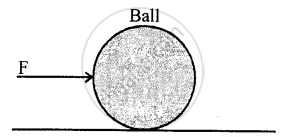
State the effect of force F in of the following diagram.
State the relationship between force, mass and acceleration. Draw graphs showing the relationship between Acceleration and mass for a constant force.
A car of mass 600 kg is moving with a speed of 10 m-1 while a scooter of mass 80 kg is moving with speed of 50 m s-1. which vehicle will require more force to stop it in the (1) same interval of time (2) same distance
Classify the following amongst contact and non-contact forces.
normal reaction force,
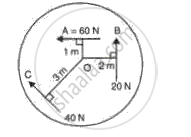
Three forces A, B and C are acting on a rigid body which can turn about O in fig.9. If all the three forces are applied simultaneously, in which direction will the body move? Explain.
State two factors affecting the turning effect of a force.
