Advertisements
Advertisements
प्रश्न
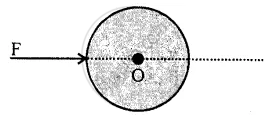
In Fig. a force F is applied in a direction passing through the pivoted point O of the body. Will the body rotate? Give reason to support your answer.
Advertisements
उत्तर
No, the body will not rotate as
Turning effect = Force × perpendicular distance of the force from the pivoted point.
= F × 0 = 0
perpendicular distance = 0 or force is parallel to the point of application of force.
APPEARS IN
संबंधित प्रश्न
An effort is applied on the bigger wheel of a gear having 32 teeth. It is used to turn a wheel of 8 teeth. Where it is used.
Name the factors affecting the turning effect of a body
To obtain a given moment of force for turning a body, the force needed can be decreased by
A wheel of diameter 2 m can be rotated about an axis passing through its center by a moment of force equal to 2.0 Nm. What minimum force must be applied on its rim?
The moment of a force about axis depends ______.
Classify the following amongst contact and non-contact forces.
electrostatic force
In a beam balance when the beam is balanced in a horizontal position, it is in ________ equilibrium.
State one factor on which the magnitude of a non-contact force depends. How does the magnitude of a non-contact force change along with distance?
Two unlike forces (parallel) of 10 N and 25 N act at a distance of 12 cm. from each other. Find the point about which the body balance.
