Advertisements
Advertisements
प्रश्न
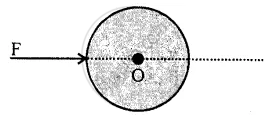
In Fig. a force F is applied in a direction passing through the pivoted point O of the body. Will the body rotate? Give reason to support your answer.
Advertisements
उत्तर
No, the body will not rotate as
Turning effect = Force × perpendicular distance of the force from the pivoted point.
= F × 0 = 0
perpendicular distance = 0 or force is parallel to the point of application of force.
APPEARS IN
संबंधित प्रश्न
How does the magnitude of this non-contact force on the two bodies depend on the distance of separation between them?
Moment of force = force × perpendicular distance of force – from the pivoted point.
Match the column
| Column A | Column B |
| (a) Camel | (1) broad and deep foundation |
| (b) Truck | (2) broad feet |
| (c) Knife | (3) six or eight tyres |
| (d) High building | (4) sharp cutting edge |
| (e) Thrust | (5) atm |
| (f) Moment of force | (6) N |
| (g) Atmospheric pressure | (7) N m |
State one way to decrease the moment of a given force about a given axis of rotation.
What are non-contact forces? Give two example
Name of S.I. unit of momentum.
A uniform metre rule of weight 10gf is pivoted at its 0 mark.
What moment of force depresses the rule?
Give an example of the following uses of a machine:
to change the direction of force
Give any two effects of a force on a non-rigid body.
Clockwise moment produced by a force about a fulcrum is considered to be ______.
