Advertisements
Advertisements
Question
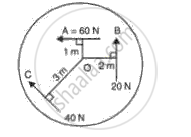
Three forces A, B and C are acting on a rigid body which can turn about O in fig.9. If all the three forces are applied simultaneously, in which direction will the body move? Explain.
Advertisements
Solution
The body will move in the direction of net torque
Net torque = sum of clockwise moments - sum of anticlockwise moments
In the given figure, force 40N is acting clockwise and forces 20N and 60N are acting anticlockwise
Net torque = (40 x 3) - [(20 x 2) + (60 x 1)}
= 120 - 100
= 20 Nm
Hence the body will move in clockwise direction about 'O'
APPEARS IN
RELATED QUESTIONS
The steering wheel of a vehicle is of large diameter.
A spanner of length 10 cm is used to open a nut by applying a minimum force of 5.0 N. Calculate the moment of force required.
State the condition when the change in the momentum of a body depends only on the change in its velocity.
A car of mass 600 kg is moving with a speed of 10 m-1 while a scooter of mass 80 kg is moving with speed of 50 m s-1. which vehicle will require more force to stop it in the (1) same interval of time (2) same distance
A uniform metre rule of weight 10gf is pivoted at its 0 mark.
What moment of force depresses the rule?
Classify the following amongst contact and non-contact forces.
Frictional force
Fig. shows a uniform meter scale weighing 100 N pivoted at its centre. Two weights of 500 N and 300 N are hung from the ruler as shown in fig.

(i) Calculate total clockwise and anticlockwise moments.
(ii) Calculate difference in clockwise moment and anticlockwise moment.
(iii) Calculate the distance from O where a 100 N weight should be suspended to balance the meter scale.
How does the distance of separation between two bodies affect the magnitude of the non-contact force between them?
A uniform metre scale is balanced at a 40 cm mark when weights of 20 gf and 5 gf are suspended at 5 cm mark and 75 cm mark respectively. Calculate the weight of metre scale.

A metal rod AB of length 80 cm is balanced at 45 cm from the end A with 100 gf weights suspended from the two ends.
- If this rod is cut at the center, C, then compare the weight of AC to the weight of BC. (Use >, < or =)
- Give a reason for your answer in (a).
