Advertisements
Advertisements
प्रश्न
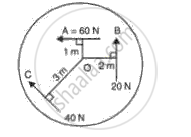
Three forces A, B and C are acting on a rigid body which can turn about O in fig.9. If all the three forces are applied simultaneously, in which direction will the body move? Explain.
Advertisements
उत्तर
The body will move in the direction of net torque
Net torque = sum of clockwise moments - sum of anticlockwise moments
In the given figure, force 40N is acting clockwise and forces 20N and 60N are acting anticlockwise
Net torque = (40 x 3) - [(20 x 2) + (60 x 1)}
= 120 - 100
= 20 Nm
Hence the body will move in clockwise direction about 'O'
APPEARS IN
संबंधित प्रश्न
How does the effect of force differ when it is applied on a rigid body?
State the S.I. unit of moment of force.
Write an expression for the change in momentum of a body of mass m moving with velocity v if v << c.
State the condition when the change in the momentum of a body depends only on the change in its velocity.
State Newton's Second law of motion. Under what conditon does it take the form F = ma?
State the relationship between force, mass and acceleration. Draw graphs showing the relationship between Acceleration and force for a constant mass.
State one factor on which the magnitude of a non-contact force depends. How does the magnitude of a non-contact force change along with distance?
State the units of moment of force.
Calculate the magnitude of the force of a couple, when the arm of the couple is 63 cm and the moment of the couple is 21 Nm.
The diagram shows wheel O pivoted at point A. Three equal forces F1, F2 and F3 act at point B on the wheel.

- Which force will produce maximum moment about A?
- Give a reason for your answer in (a).
