Advertisements
Advertisements
प्रश्न
A half metre rod is pivoted at the centre with two weights of 20gf and 12gf suspended at a perpendicular distance of 6 cm and 10 cm from the pivot respectively as shown below.
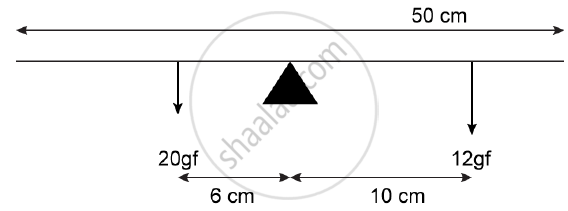
1) Which of the two forces acting on the rigid rod causes clockwise moment?
2) Is the rod in equilibrium?
3) The direction of 20 kgf force is reversed. What is the magnitude of the resultant moment of the forces on the rod?
Advertisements
उत्तर
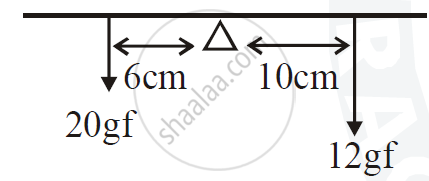
1) The force of 12 gf causes a clockwise moment.
2) Clockwise moment = 12 x 10 gf cm
= 120 gf cm
Anti clockwise moment = 20 x 6 gf cm
= 120 gf cm
∵ Clockwise moment = Anti clockwise moment
∴ The rod is in equilibrium.
3) If the direction of 20 gf force is reversed, it will also create a clockwise moment.
Resultant moment = (120 + 120) gf cm (clockwise)
= 240 gf cm
APPEARS IN
संबंधित प्रश्न
A nut is opened by a wrench of length 20 cm. If the least force required is 2N, find the moment of force needed to loosen the nut.
The hand flour grinder is provided with a handle near the rim.
What are contact forces? Give two Example
Name of S.I. unit of momentum.
A spanner (or wrench) has a long handle. Why?
A wheel of diameter 2 m is shown in the figure with the axle at O. A force F = 2 N is applied at B in the direction shown in the figure. Calculate the moment of force about
- the centre O, and
- the point A.

Two forces each of magnitude 10 N act vertically upwards and downwards respectively at the two ends A and B of a uniform rod of length 4 m which is pivoted at its midpoint O as shown in the figure. Determine the magnitude of the resultant moment of forces about the pivot O.

Classify the following amongst contact and non-contact forces.
electrostatic force
Two unlike forces (parallel) of 10 N and 25 N act at a distance of 12 cm. from each other. Find the point about which the body balance.
A door lock is opened by turning the lever (handle) of length 0.2 m. If the moment of force produced is 1 Nm, then the minimum force required is ______.
