Advertisements
Advertisements
प्रश्न
How does the effect of force differ when it is applied on a non-rigid body?
Advertisements
उत्तर
When a force is applied on a non-rigid object it changes interspacing between its constituent particle and causes a change in its dimensions and can produce motion in it.
APPEARS IN
संबंधित प्रश्न
Name the factors affecting the turning effect of a body
State the S.I. unit of moment of force.
A rocket is moving at a constant speed in space by burning its fuel and ejecting out the burnt gases through a nozzle. Answer the following
1) Is there any change in the momentum of the rocket? if yes, what causes the change in momentum?
2) Is there any force acting on the rocket? if yes, how much?
State Newton's third law of motion.
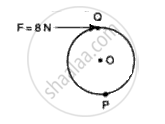
A wheel of diameter 3 m is shown in fig. 2 with axle at 0. A force F = 8 N is applied at Q in the direction shown in figure. Calculate the moment of force about:
(i) centre o, and
(ii) point p.
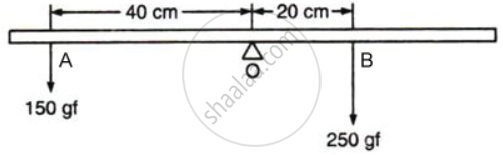
The diagram shows a uniform metre rule weighing 100gf, pivoted at its centre O. Two weights 150gf and 250gf hang from the point A and B respectively of the metre rule such that OA = 40 cm and OB = 20 cm. Calculate :
the total clockwise moment about O
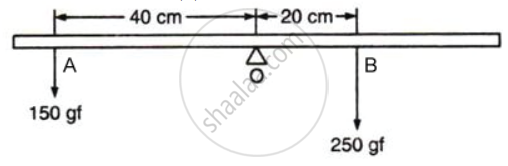
The diagram shows a uniform metre rule weighing 100gf, pivoted at its centre O. Two weights 150gf and 250gf hang from the point A and B respectively of the metre rule such that OA = 40 cm and OB = 20 cm. Calculate :
the difference of anticlockwise and clockwise moment
State two factors on which moment of the force about a point depends.
On a see-saw, two children of masses 30 kg and 50 kg are sitting on one side of it at distance 2 m and 2.5 m respectively, from its middle, where should a man of mass 74 kg sit to balance it?
A door lock is opened by turning the lever (handle) of length 0.2 m. If the moment of force produced is 1 Nm, then the minimum force required is ______.
