Advertisements
Advertisements
प्रश्न
How does the effect of force differ when it is applied on a non-rigid body?
Advertisements
उत्तर
When a force is applied on a non-rigid object it changes interspacing between its constituent particle and causes a change in its dimensions and can produce motion in it.
APPEARS IN
संबंधित प्रश्न
How does the magnitude of this non-contact force on the two bodies depend on the distance of separation between them?
An effort is applied on the bigger wheel of a gear having 32 teeth. It is used to turn a wheel of 8 teeth. Where it is used.
Moment of force = force × perpendicular distance of force – from the pivoted point.
A spanner (or wrench) has a long handle. Why?
Two forces each of magnitude 10 N act vertically upwards and downwards respectively at the two ends A and B of a uniform rod of length 4 m which is pivoted at its midpoint O as shown in the figure. Determine the magnitude of the resultant moment of forces about the pivot O.

A uniform metre scale can be balanced at the 70.0 cm mark when a mark when a mass 0.05 kg is hung from the 94.0 cm mark
- draw a diagram of the arrangement
- Find the mass of the metre scale
(i) What do you understand by the term couple of forces?
(ii) Calculate the moment of a couple shown in fig.
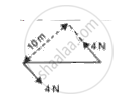
A uniform metre scale is balanced at a 40 cm mark when weights of 20 gf and 5 gf are suspended at 5 cm mark and 75 cm mark respectively. Calculate the weight of metre scale.
A door lock is opened by turning the lever (handle) of length 0.2 m. If the moment of force produced is 1 Nm, then the minimum force required is ______.
The diagram in Fig shows two forces F1 = 5 N and F2 = 3 N acting at points A and B respectively of a rod pivoted at a point O, such that OA = 2 m and OB = 4 m.
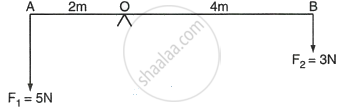
Calculate:
- the moment of force F1 about O.
- the moment of force F2 about O.
- total moment of the two forces about O.
