Advertisements
Advertisements
Question
How does the effect of force differ when it is applied on a non-rigid body?
Advertisements
Solution
When a force is applied on a non-rigid object it changes interspacing between its constituent particle and causes a change in its dimensions and can produce motion in it.
APPEARS IN
RELATED QUESTIONS
A nut is opened by a wrench of length 20 cm. If the least force required is 2N, find the moment of force needed to loosen the nut.
A half metre rod is pivoted at the centre with two weights of 20gf and 12gf suspended at a perpendicular distance of 6 cm and 10 cm from the pivot respectively as shown below.
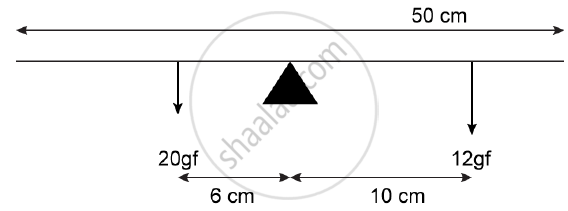
1) Which of the two forces acting on the rigid rod causes clockwise moment?
2) Is the rod in equilibrium?
3) The direction of 20 kgf force is reversed. What is the magnitude of the resultant moment of the forces on the rod?
To obtain a given moment of force for turning a body, the force needed can be decreased by
State the S.I. unit of moment of force.
The steering wheel of a vehicle is of large diameter.
On what factors does the effect of thrust on a surface depend?
State Newton's Second law of motion. Under what conditon does it take the form F = ma?
A, B and C are the three forces each of magnitude 4 N acting in the plane of the paper as shown in Figure. The point O lies in the same plane.
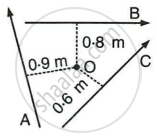
- Which force has the least moment about O? Give a reason.
- Which force has the greatest moment about O? Give a reason.
- Name the forces producing
(a) Clockwise
(b) anticlockwise moments. - What is the resultant torque about the point O?
A steering wheel of diameter 0.5 m is rotated anticlockwise by applying two forces each of magnitude 6 N. Draw a diagram to show the application of forces and calculate the moment of forces applied.
Write the expression for the moment of force about a given axis.
