Advertisements
Advertisements
Question
A uniform metre scale can be balanced at the 70.0 cm mark when a mark when a mass 0.05 kg is hung from the 94.0 cm mark
- draw a diagram of the arrangement
- Find the mass of the metre scale
Advertisements
Solution
1) A diagram of the given arrangement is shown below.
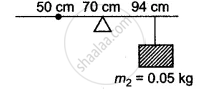
2) As the given meter scale is a uniform scale. So its centre of gravity lies at 50 cm. Let the mass of the meter-scale be W1 kg.
From the principle of moments
Anticlockwise moment = clockwise moment
m1x1 = m2x2
m1 × (70 − 50) = 0.05 × (94 − 70)
m1 = `(0.05 xx 24)/20`
= 0.06 kg
= 60 g
RELATED QUESTIONS
An effort is applied on the bigger wheel of a gear having 32 teeth. It is used to turn a wheel of 8 teeth. Where it is used.
Define force.
What are non-contact forces? Give two example
The moment of a force about axis depends ______.
The moment of a force of 10 N about a fixed point O is 5 N m. Calculate the distance of the point O from the line of action of the force.
A steering wheel of diameter 0.5 m is rotated anticlockwise by applying two forces each of magnitude 6 N. Draw a diagram to show the application of forces and calculate the moment of forces applied.
State the effects that a force can produce. Given one example of each.
Calculate the length of arm of couple, if a force of 13 N produces a moment of couple of 14.3 Nm.
Clockwise moment produced by a force about a fulcrum is considered to be ______.
The diagram shows wheel O pivoted at point A. Three equal forces F1, F2 and F3 act at point B on the wheel.

- Which force will produce maximum moment about A?
- Give a reason for your answer in (a).
